Are You Ignoring 11 Gauge Steel's Secrets?
- Share
- Issue Time
- Apr 15,2026
Summary
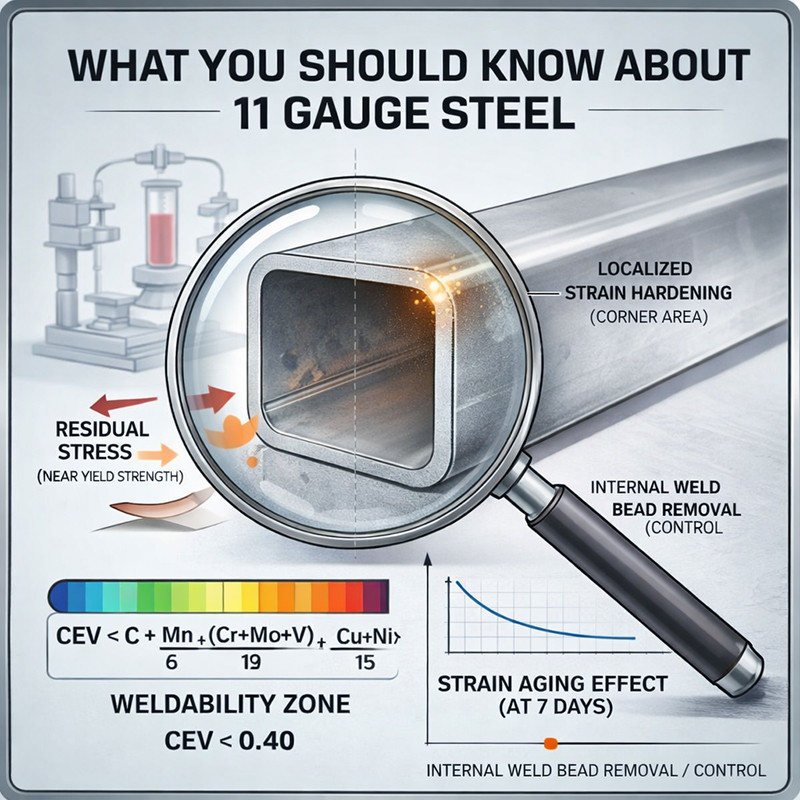
When you order 11 Gauge (3.0mm) structural steel, you aren’t just buying a thickness; you’re buying a personality. In the steel world, 11 gauge sits in a "Goldilocks zone"—too thick to be treated like sheet metal, yet too thin to behave like heavy plate.
Are You Ignoring 11 Gauge Steel's Secrets?
When you order 11 Gauge (3.0mm) structural steel, you aren’t just buying a thickness; you’re buying a personality. In the steel world, 11 gauge sits in a "Goldilocks zone"—too thick to be treated like sheet metal, yet too thin to behave like heavy plate.
Because of this unique positioning, 11 gauge steel exhibits behaviors that can either make your project a masterpiece or a logistical nightmare. If you’ve ever wondered why a perfectly straight tube suddenly warps after a laser cut, or why a batch of steel feels "brittle," you’re dealing with the three hidden traits of 11 gauge steel.
The "Muscle Memory" (The Springback Factor)
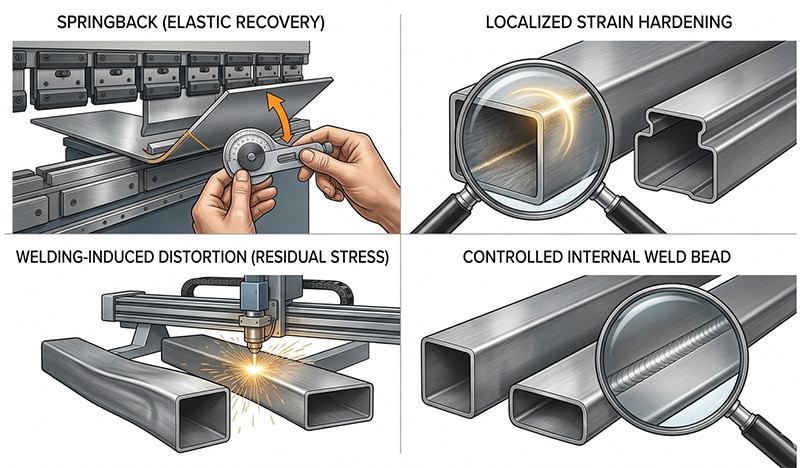
In precision manufacturing, 11 gauge steel is notorious for its "memory." When you bend a 3.0mm plate to a 90-degree angle, the atoms inside are engaged in a silent tug-of-war.
The Reality: The moment the press brake releases, the steel "remembers" its flat shape and kicks back by 1° to 3°.
The Human Touch: Unlike thinner gauges that are easily tamed, 11 gauge requires an experienced operator who understands Over-Bending. If your supplier doesn't account for the specific yield strength of that batch, your "square" tubes will arrive slightly trapezoidal, ruining your assembly fit-up.
The "Hardened Heart" (Strain Hardening)
11 Gauge steel often undergoes significant cold-forming to reach its final shape. While this makes the steel stronger (increasing its yield strength), it comes at a cost: Ductility.
We call this "Work Hardening." If a factory "over-works" the 3.0mm strip to achieve a razor-sharp corner radius, the steel becomes stressed and brittle. Have you ever had a drill bit smoke and burn out while trying to pierce a 3.0mm tube? That’s not a bad drill bit—that’s the steel’s "hardened heart" fighting back. High-quality manufacturing ensures a balance, giving you strength without sacrificing the ability to weld or drill.
The "Silent Battle" (Residual Stress Release)
This is the most "mysterious" phenomenon in steel processing. Every 11 Gauge tube is a pressurized vessel of internal energy. During the rolling and welding process, immense stress is locked inside the metal.
The "Snake" Effect: If you take a 6-meter length of 11 gauge SHS and perform a longitudinal slit, the tube will often twist or splay open instantly.
For engineers designing complex frames, understanding Stress Relief is vital. If you plan on heavy laser-cutting or asymmetrical welding, you must choose steel that has been "tuned" during the cooling process. Otherwise, your straight frame will look like a literal snake by the time it hits the assembly line.
The 0.2mm Secret: The Internal Weld Bead
When 11 gauge steel is ERW, a "scar" or bead is formed inside the tube. While the outside looks smooth and polished, the Internal Scarfing tells the real story.
If a manufacturer is careless and leaves a jagged internal bead—or worse, cuts too deep into the 3.0mm wall while trying to remove it—they create a Stress Concentration Point. Over time, vibration and load will cause the tube to crack along this "invisible line." A premium 11 gauge tube should have an internal seam so smooth it’s almost felt rather than seen.
Why Thickness is Only Half the Story
At 3.0mm (11 Gauge), steel is a living material. It has a "temper" that reacts to heat, a "memory" that resists bending, and "internal stress" that waits for the right moment to release.
When sourcing for your next project—whether it's solar mounting racks, automotive frames, or architectural skeletons—don't just ask for "11 Gauge." Ask your partner about their Springback compensation, their CEV (Carbon Equivalent Value) for weldability, and their Stress-Relief protocols.
True quality isn't just measured by a caliper; it's measured by how the steel behaves long after it leaves the mill.
Q1: How Thick Is 11 Gauge Steel In Millimeters?
For standard carbon steel, 11 gauge is approximately 0.1196 inches, which translates to 3.038 mm. However, keep in mind that galvanized and stainless steel have slightly different gauge charts. In the structural steel industry, it is commonly referred to as 3.0mm thickness.
Q2: Why Does My 11 Gauge Steel Tube Warp When I Laser-Cut It?
This is caused by the release of residual stress. During the cold-forming and welding processes at the mill, 11 gauge steel builds up internal tension. When you cut into the tube—especially with large or asymmetric holes—that locked-in stress is suddenly released, causing the metal to twist or warp. Purchasing stress-relieved steel can prevent this.
Q3: Is 11 Gauge Steel Hard To Bend?
While it is manageable with a standard press brake, 11 gauge steel is notorious for elastic recovery. Because of its specific thickness and yield strength, the steel will naturally try to return to its flat shape. Operators usually need to "over-bend" the metal by 1 to 3 degrees to achieve a perfect 90-degree angle.
Q4: Why Do 11 Gauge Square Tubes Sometimes Crack During Fabrication?
If a 3.0mm tube cracks during secondary bending or drilling, it is usually due to excessive strain hardening at the factory. If the steel is overworked to create very sharp corner radii, it loses its ductility and becomes brittle. A balanced corner radius prevents this issue.
Q5: What Is Internal Scarfing, And Why Does It Matter For 3.0mm Tubes?
Internal scarfing is the process of removing the inner weld bead created during ERW. For an 11 gauge tube, if the factory leaves a jagged bead or cuts too deeply into the 3.0mm wall while removing it, it creates a stress concentration point. Under heavy load or vibration, the tube can crack from the inside out along this seam.