Can You Bury Black Iron Gas Pipe Underground? Code Requirements, Corrosion & Protection
- Share
- Issue Time
- Aug 20,2026
Summary
Can black iron gas pipe be buried underground? Learn why bare steel corrodes in soil and how coatings, joint protection, and code requirements affect selection.
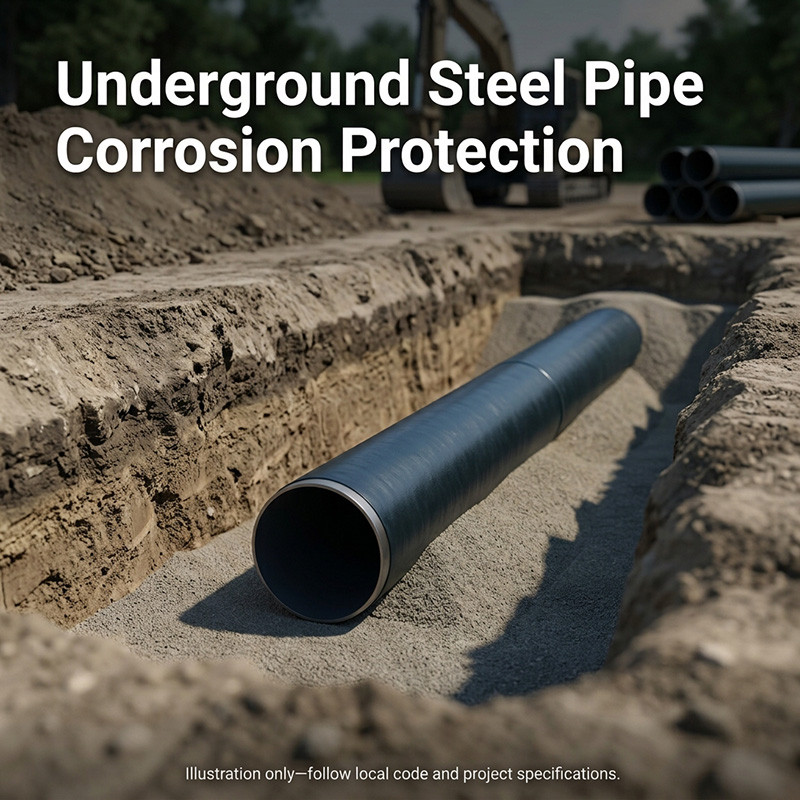
Bare black iron or black steel gas pipe should generally not be buried directly in soil without an approved corrosion-protection system. Steel can be used for underground fuel-gas applications, but the pipe, coating, joints, installation method, testing, and protection requirements must comply with the locally adopted fuel-gas code, project specifications, and requirements of the authority having jurisdiction (AHJ).
The main issue is not whether black steel can carry gas. It is external corrosion. When bare steel comes into contact with soil, moisture, dissolved salts, oxygen, and other environmental factors, corrosion can occur, potentially causing localized pitting, wall loss, and eventually loss of pipe integrity.
Important: This article provides general information about steel pipe materials and corrosion protection. Underground fuel-gas piping must be designed, installed, tested, and approved according to applicable local codes, project specifications, and AHJ requirements. Consult a licensed gas contractor or qualified engineer for a specific installation.
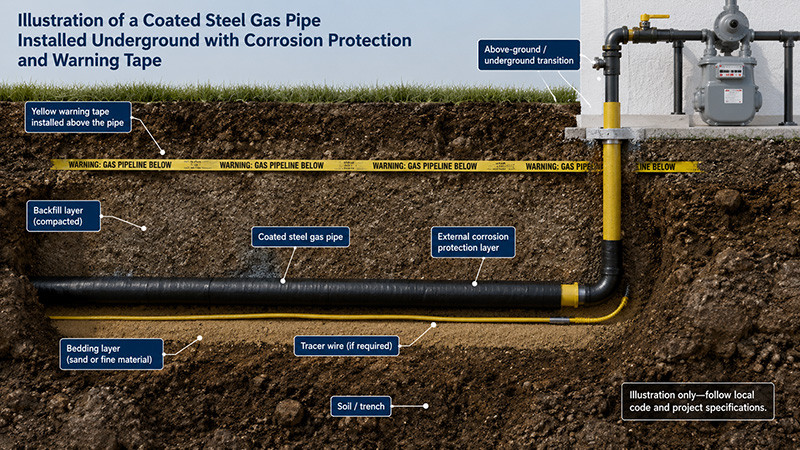
Can Black Iron Gas Pipe Be Buried Underground?
In gas-piping discussions, “black iron pipe” commonly refers to ungalvanized carbon steel pipe, often called black steel pipe in industrial and procurement contexts.
Black steel is widely used for above-ground gas piping. However, bare black steel should not normally be placed directly in soil for underground fuel-gas service unless the complete piping system includes an appropriate corrosion-control strategy.
Depending on the applicable code and project requirements, an underground steel gas-piping system may require:
A factory-applied corrosion-resistant coating or insulating jacket
Protection for joints, fittings, welds, cut ends, and field repairs
Cathodic protection where required by the design
Adequate soil cover and physical protection
Warning tape, tracer wire, or other locating measures where applicable
Pressure testing and inspection before the system is placed into service
The exact requirements depend on the local jurisdiction, adopted code edition, system pressure, site conditions, soil environment, and project specification.
In the United States, commonly referenced model fuel-gas codes include the International Fuel Gas Code (IFGC) and NFPA 54, National Fuel Gas Code. Local authorities may adopt these codes with amendments or additional requirements.
The key distinction is simple: bare steel is vulnerable to soil corrosion, while properly protected steel can be suitable for certain underground applications when the complete system complies with applicable requirements.
Why Does Bare Black Steel Corrode Underground?
Bare black steel pipe does not have a dedicated external corrosion-protection coating. Once buried, its outside surface may be exposed to moisture, dissolved salts, changing soil chemistry, oxygen, and electrical interference.
These conditions can create electrochemical corrosion cells on the steel surface. Corrosion may begin as localized metal loss and develop into pitting corrosion, which removes material from specific areas rather than uniformly reducing the complete pipe wall.
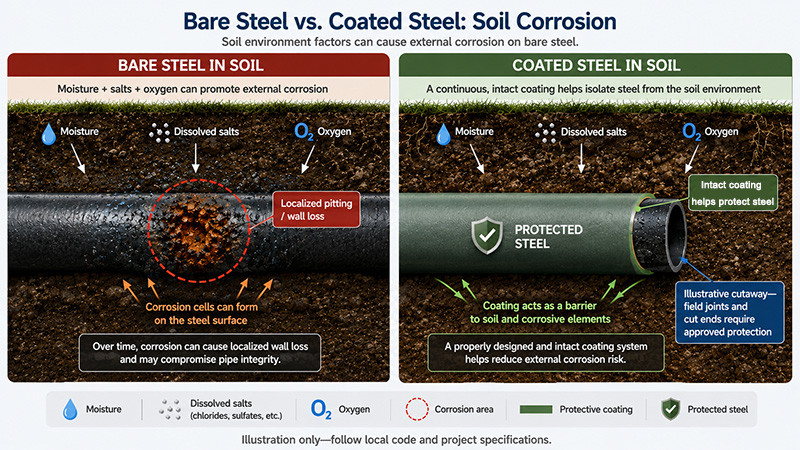
The severity of corrosion depends on the actual installation environment, including:
Soil resistivity
Moisture content and drainage
Soil pH
Chlorides, sulfates, and other dissolved salts
Oxygen availability
Stray electrical currents
Contact with dissimilar metals
Coating damage
Backfill material and installation quality
Soil corrosivity is commonly screened by resistivity — the lower the resistivity, the more aggressive the soil:
| Soil Resistivity (Ω·cm) | Corrosivity Rating | Typical Behavior of Bare Steel |
| > 20,000 | Essentially non-corrosive | Very slow, mostly cosmetic rusting |
| 10,000–20,000 | Mildly corrosive | Moderate general corrosion |
| 5,000–10,000 | Moderately corrosive | Noticeable pitting over years |
2,000–5,000 | Corrosive | Significant pitting; coating + CP advised |
500–2,000 | Highly corrosive | Rapid localized attack; full protection system required |
< 500 | Extremely corrosive | Not suitable for bare steel |
(Reference framework: common NACE/AMPP soil-corrosivity screening practice; site-specific evaluation is always required.)
There is no reliable universal service-life estimate for bare buried steel pipe. A pipe that performs well in one soil environment may experience much faster corrosion in another. For this reason, pipe selection should consider the soil environment and corrosion-protection system, not only pipe grade and wall thickness.
When Can Steel Gas Pipe Be Used Underground?
Steel pipe can be used underground when the complete system incorporates a suitable corrosion-control strategy and complies with applicable requirements.
The system should be considered as a whole, including pipe material, wall thickness, external coating, field-joint protection, fittings, underground-to-above-ground transitions, installation conditions, testing, inspection, and cathodic protection where applicable.
A high-quality steel pipe can still be vulnerable if its coating is damaged during transport or installation, or if exposed field joints are not properly protected.
Factory-Coated Steel Pipe
Factory-coated steel pipe uses an external coating or jacket to separate the steel surface from surrounding soil. Depending on the project, the protection system may use polymeric coatings, fusion-bonded epoxy, liquid-applied coatings, multi-layer systems, or other approved materials.
Factory application can provide more consistent surface preparation and coating quality than uncontrolled site application. However, coating integrity must be maintained throughout manufacturing, transportation, handling, joining, installation, and burial.
If a coating is damaged, bare steel may be exposed and become a localized corrosion point. Cut ends, weld areas, fittings, and field joints may therefore require compatible repair or protection methods.
Field Joints and Cathodic Protection
Even when the pipe body is factory coated, field joints, fittings, welds, and cut ends may require additional corrosion protection.
Depending on the coating system, this may involve compatible wrapping materials, heat-shrink sleeves, primers, liquid-applied coatings, or other qualified joint-protection systems. The correct method should follow the coating manufacturer's instructions, applicable code, and project specification.
Ordinary electrical tape, duct tape, or general-purpose adhesive tape should not be assumed to provide suitable underground fuel-gas corrosion protection.
Cathodic protection may also be incorporated into the corrosion-control strategy for buried metallic piping. Depending on the design, this may use sacrificial anodes or impressed-current systems. Where required, cathodic protection can work with an appropriate external coating to provide additional long-term corrosion control.
Black Steel vs. Coated Steel vs. HDPE
The best underground gas-piping material depends on the complete application—not simply on whether the pipe can physically be buried.
| Material / System | Resistance to Soil Corrosion | Mechanical Strength | Main Consideration |
| Bare black steel | Low in direct soil contact | High | Requires an appropriate corrosion-control system before underground installation |
| Coated or wrapped steel | Depends on coating integrity and field-joint protection | High | Coating selection, inspection, repair, and joint protection are critical |
| DPE / PE gas pipe | High resistance to electrochemical soil corrosion | Lower than steel | Must meet applicable gas-pipe, pressure, joining, transition, locating, and mechanical-protection requirements |
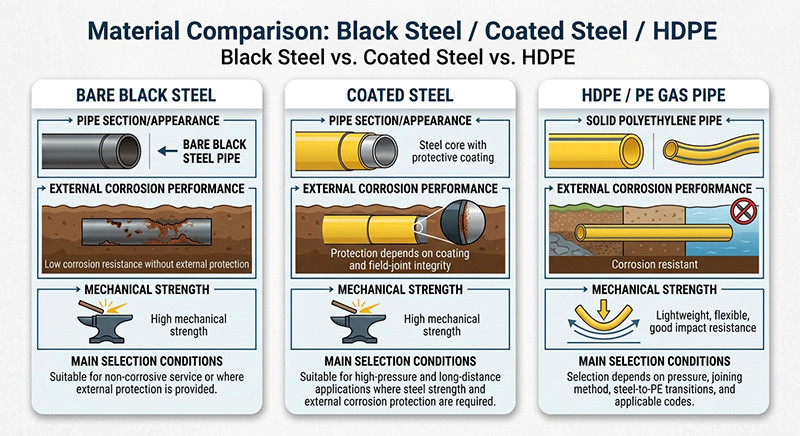
Coated steel may be selected where steel strength, impact resistance, transition compatibility, or connection to existing steel infrastructure is important.
HDPE or PE gas pipe is widely used for underground gas distribution because it does not rust and has strong resistance to many forms of soil corrosion. However, HDPE is not automatically interchangeable with steel. Its use depends on permitted gas service, operating pressure, temperature, pipe standard, SDR, joining method, transition fittings, mechanical protection, locating requirements, and local code provisions.
What Do Fuel-Gas Codes Typically Require?
Fuel-gas piping requirements vary by jurisdiction. In the United States, local authorities may adopt and amend model codes such as the IFGC and NFPA 54.
For underground metallic gas piping, applicable codes and project specifications may address:
Approved pipe material and pressure rating
External corrosion protection
Factory-applied coatings or approved field-applied systems
Protection of fittings, joints, welds, and cut ends
Cathodic protection where required
Underground-to-above-ground transitions
Physical protection and required soil cover
Warning tape, tracer wire, or other locating measures
Pressure testing, inspection, commissioning, and approval
Do not use one generic burial depth, test pressure, or coating type as a universal requirement. The correct approach depends on the locally adopted code, project design, site conditions, and AHJ approval.
How Deep Should a Buried Gas Line Be?
Cover depth is one of the most frequently inspected items on a buried gas line. The table below shows typical minimum cover requirements from the two most widely referenced US model codes:
| Piping Location | IFGC / NFPA 54 Typical Minimum Cover |
| Under open ground (yard, right-of-way) | 12 in. (300 mm) |
| Under driveways, parking areas | 18 in. (450 mm) |
| Under streets, roads, or rail crossings | 24 in. (600 mm) |
In or under a building slab | Typically requires sleeve + additional protection |
Notes:
-Values are typical minimum cover to top of pipe; always verify the locally adopted code edition and AHJ amendments.
- Where rock or obstructions make full depth impractical, codes generally allow reduced depth with additional physical protection (e.g., concrete pad or casing).
- Deeper burial than the minimum is common in frost zones to keep the line below frost depth and avoid condensation issues.
Locating and Testing: Tracer Wire and Pressure Tests
Two installation details decide whether a buried steel gas line can be found and trusted years later:
Tracer wire (locator wire). Metallic pipe can be located electromagnetically only if a tracer wire is taped to the pipe along its full run and brought above grade at accessible points (valve boxes, risers). Plastic pipe is invisible to locators without it. NFPA 54 and most local codes require tracer wire or other locating means on buried fuel-gas piping installed after the code adoption date.
Pressure testing before backfill. The installed line is pressure-tested with air or inert gas before being placed in service. Common practice for low-pressure systems is a test around 1.5× the working pressure held for a defined period (often 10–30 minutes depending on code edition and system volume) with no measurable loss. The test pressure, duration, and gauge readings are typically recorded for the AHJ.
Warning tape. A detectable warning tape buried 6–12 in. above the pipe gives the next excavator a last line of defense before contact.
Can Galvanized Steel Replace Black Steel Underground?
Do not assume that galvanized steel automatically becomes suitable for underground fuel-gas service simply because it has a zinc coating.
Galvanizing can provide a degree of corrosion resistance, but underground suitability depends on the applicable code, material compatibility, soil environment, coating condition, installation method, and project approval. Additional corrosion protection may still be required.For a detailed comparison, see galvanized pipe for gas and our guide to zinc coating thickness.
Before selecting galvanized steel for buried gas service, confirm the permitted material and corrosion-control requirements with the applicable code, project specification, and AHJ.
Frequently Asked Questions
Can You Bury Black Iron Gas Pipe Underground?
Bare black iron or black steel pipe should generally not be placed directly in soil for underground fuel-gas service without an approved corrosion-protection system. The final decision depends on the applicable code, project design, and AHJ requirements.
Can Coated Steel Pipe Be Buried Underground?
Yes. Steel pipe with an approved corrosion-protection system can be used for certain underground gas and infrastructure applications. The coating, field joints, fittings, repairs, installation, testing, and approval process must meet applicable requirements.
Does Buried Steel Pipe Need Corrosion Protection?
For underground fuel-gas applications, corrosion protection is a critical consideration. The appropriate method depends on the pipe material, soil environment, coating system, design requirements, applicable codes, and local approval process.
Is HDPE Better Than Steel for Underground Gas Piping?
Not necessarily. HDPE provides strong resistance to soil corrosion, while steel provides greater mechanical strength and may be preferred for specific infrastructure, transition, or operating requirements.
The best choice depends on the complete piping system.
What Should You Specify When Buying Steel Pipe?
For an underground gas or infrastructure project, the purchasing specification should go beyond outside diameter × wall thickness.
Important items include:
1. Pipe Standard and Steel Grade
Specify the applicable ASTM, EN, API, or project standard, material grade, and required mechanical properties.
2. Dimensions and Tolerances
Confirm outside diameter, wall thickness, length, end type, straightness, ovality, and dimensional tolerances.
3. Corrosion-Protection System
Define the coating type, surface preparation, coating thickness, repair method, field-joint protection, inspection requirements, and cathodic protection where required.
4. Connections and Installation Conditions
Clarify whether the project uses welded, threaded, flanged, mechanical, or transition connections, along with relevant installation requirements.
5. Testing and Documentation
Confirm required pressure testing, coating inspection, holiday detection where applicable, visual inspection, Mill Test Certificates, coating records, and third-party inspection documentation.
A clear specification helps prevent a common mistake: ordering the correct steel pipe grade and dimensions while leaving the corrosion-protection system undefined.
Conclusion
Can black iron gas pipe be buried underground? Bare black steel should generally not be installed in direct soil contact without an approved corrosion-protection system.
Steel may be used for underground gas applications when the complete system—including pipe material, external coating, field-joint protection, installation method, testing, and approval—meets applicable code and project requirements.
For buyers and project teams, underground pipe selection should address both structural performance and long-term corrosion control before a purchase order is issued.
Get a Quote for Your Underground Gas Pipe Project
Yuantai Derun supplies carbon and structural steel pipe for international infrastructure and engineering projects, including black steel pipe to ASTM A53 in NPS 1/2"–8", factory-coated line pipe, and project-specific corrosion-protection systems. Product standards, dimensions, wall thickness, coating requirements, inspection scope, and material certification can be discussed according to project-specific requirements.
For buried, wet, or corrosive environments, define the required pipe standard, steel grade, dimensions, corrosion-protection system, end requirements, testing scope, and documentation before procurement. we help you specify the pipe and corrosion-control system as one complete soiution.