EN 10255 vs ASTM A53 vs BS 1387: Cross-Reference Guide for Pipe Selection
- Share
- Issue Time
- Jun 11,2026
Summary
Compare EN 10255, ASTM A53 & BS 1387 steel pipes. Explore critical differences in dimensional tolerances, threading requirements, and multi-standard mill compliance.
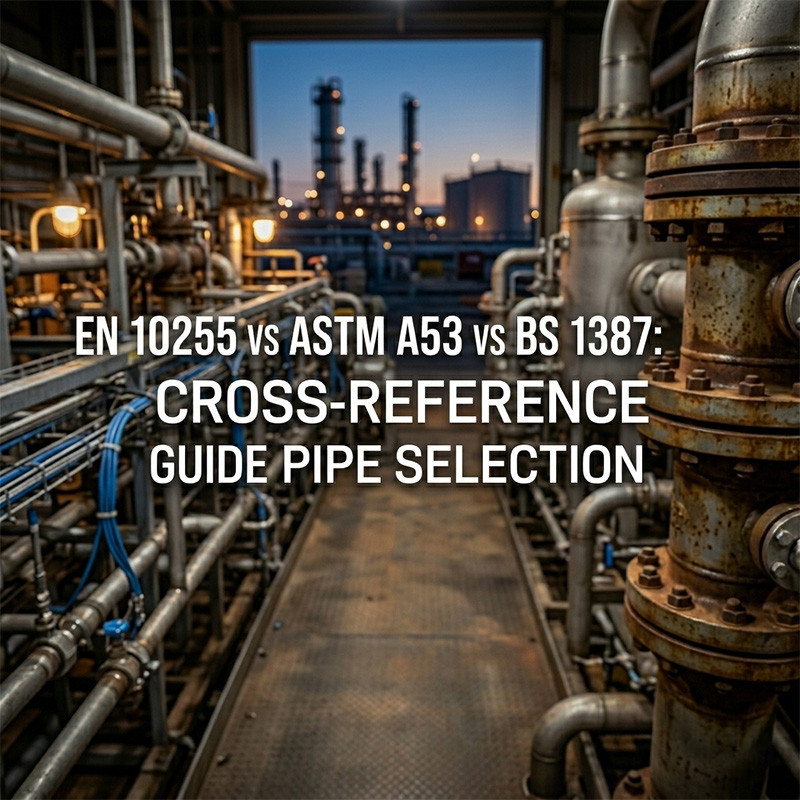
If you just got a piping blueprint from an overseas contractor, chances are your spec sheet is a bit of a mess. One section asks for European EN 10255, another demands American ASTM A53, and a few legacy files might still list old British BS 1387.
When you are buying steel pipes, you cannot just look at the price per ton. You need to know if these standards actually match up on the factory floor, how their dimensions differ, and whether you can safely swap them without failing site inspections.
Is BS 1387 Still Used? What Replace it.
Let’s clear up the legal status first.It was replaced in practice by EN 10255 and is now mainly used as a legacy market reference.
However, despite being officially retired for over two decades, "BS 1387" is still widely used as an industry slang term by procurement managers and engineers across the Middle East, Southeast Asia, and parts of Africa. If your legacy project blueprints still request BS 1387, you can seamlessly transition to modern EN 10255 non-alloy steel tubes using this exact category mapping:
· BS 1387 Light (Class A) is commonly cross-referenced to EN 10255 Type L
· BS 1387 Medium (Class B) is commonly cross-referenced to EN 10255 Type M
· BS 1387 Heavy (Class C) is commonly cross-referenced to EN 10255 Type H
Sizing and Tolerance Differences That Ruin On-Site Threading
Where most buyers get tripped up is the dimensional philosophy.
EN 10255 and BS 1387 define outside diameter with specified tolerances,which is important for threaded applications.If the pipe shape has even a tiny bit of ovality or out-of-roundness, the threading machine cuts unevenly, leading to leaked joints or torn threads.
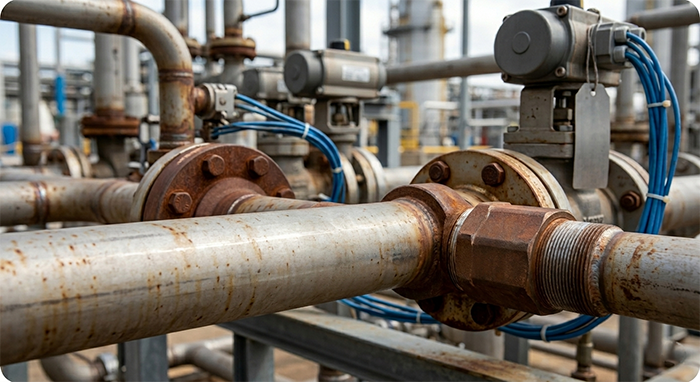
ASTM A53 is specified by nominal pipe size and standard dimensional tolerances, which differ from EN/BS reference conventions.
To see how these wall thicknesses and diameters actually line up when you try to cross-reference them, look at the technical data below.
Cross-Standard Dimensions & Wall Thickness Comparison
| Nominal Size (DN / Inch) | EN 10255 (S195T)Type / Wall (mm) | EN 10255 (S195T)OD Range (mm) | ASTM A53 (Grade A/B)Schedule / Wall (mm) | ASTM A53 (Grade A/B)Fixed OD (mm) | BS 1387 (Legacy)Class / Wall (mm) | BS 1387 (Legacy)OD Range (mm) |
| DN15 (1/2") | Medium: 2.60 | 21.0 - 21.4 | SCH 40: 2.77 | 21.34 | Class B: 2.60 | 21.1 - 21.7 |
| DN20 (3/4") | Medium: 2.60 | 26.4 - 26.9 | SCH 40: 2.87 | 26.67 | Class B: 2.60 | 26.6 - 27.2 |
| DN25 (1") | Medium: 3.20 | 33.2 - 33.8 | SCH 40: 3.38 | 33.40 | Class B: 3.20 | 33.4 - 34.2 |
DN32 (1-1/4") | Medium: 3.20 | 41.9 - 42.5 | SCH 40: 3.56 | 42.16 | Class B: 3.20 | 42.1 - 42.9 |
DN40 (1-1/2") | Medium: 3.20 | 47.8 - 48.4 | SCH 40: 3.68 | 48.26 | Class B: 3.20 | 48.0 - 48.8 |
DN50 (2") | Medium: 3.60 | 59.6 - 60.2 | SCH 40: 3.91 | 60.33 | Class B: 3.60 | 59.7 - 60.8 |
DN65 (2-1/2") | Medium: 3.60 | 75.2 - 76.0 | SCH 40: 5.16 | 73.03 | Class B: 3.60 | 75.3 - 76.6 |
DN80 (3") | Medium: 4.00 | 87.9 - 88.7 | SCH 40: 5.49 | 88.90 | Class B: 4.00 | 88.0 - 89.5 |
DN100 (4") | Medium: 4.50 | 113.0 - 113.9 | SCH 40: 6.02 | 114.30 | Class B: 4.50 | 113.1 - 114.9 |
Approximate cross-reference for general service pipe only.
Market Note: EN 10255 Medium is commonly cross-referenced with BS 1387 Class B, whereas ASTM A53 Schedule 40 usually requires a separate size-by-size review because its wall thickness is often greater.
Metallurgy Check: S195T Steel vs. ASTM A53 Grade A
Looking past the dimensions, you have to look at the actual chemistry of the steel. You cannot just buy based on general steel grades and hope it welds correctly on site.
EN 10255 specifies S195T is a non-alloy steel grade commonly used for tubes intended for bending, threading, and general fluid service. They are required continuous bending, cold forming, and threading.
Let's look at how its mechanical performance limits hold up against the basic American standard:
EN 10255 S195T: Yield Strength ≥ 195MPa | Tensile Strength 320-460MPa.
ASTM A53 Grade A: Yield Strength ≥205MPa | Tensile Strength ≥330MPa.
Its lower yield strength is one reason it remains suitable for threading and field forming. It keeps the steel highly workable, meaning it takes threads cleanly without cracking the pipe wall or dulling the threading dies prematurely.
Mill-Level Execution: How We Handle Multi-Standard Deliveries
When you are ordering large-scale batches for international infrastructure or regional distribution, you need a mill that understands how to transition between these specifications without taking shortcuts.
At YUANTAI DERUN GROUP, our production lines handle orders across all three standard profiles based on your specific project submittals:
Traceable Digital Quality Assurance: We eliminate guesswork by linking each shipment to digital tracking. Each batch is supplied with a Mill Test Certificate and corresponding heat/batch traceability records. And ladle chemical control, to support weldability in field applications.
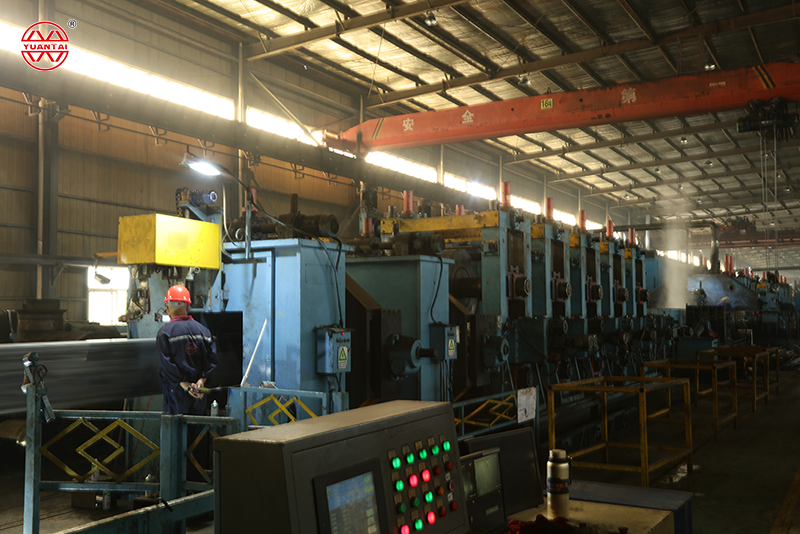
Inside our advanced sizing and forming mill, where dimensional tolerances and R-angle precision are strictly controlled to ensure cross-standard compliance.
Anti-Corrosion Benchmarks: Our hot-dip galvanizing lines hit rigorous anti-corrosion metrics, keepinggalvanizing thickness is controlled according to project requirements and relevant coating standards to prevent premature rust in high-moisture setups.
Testing Rigor: Products are typically verified through non-destructive testing methods, including eddy current and hydrostatic testing, according to order specifications to help identify potential micro-cracks before loading. In addition, laboratory salt spray testing is conducted on a regular basis to monitor the corrosion resistance and durability of our finished structural steel products under harsh environments.
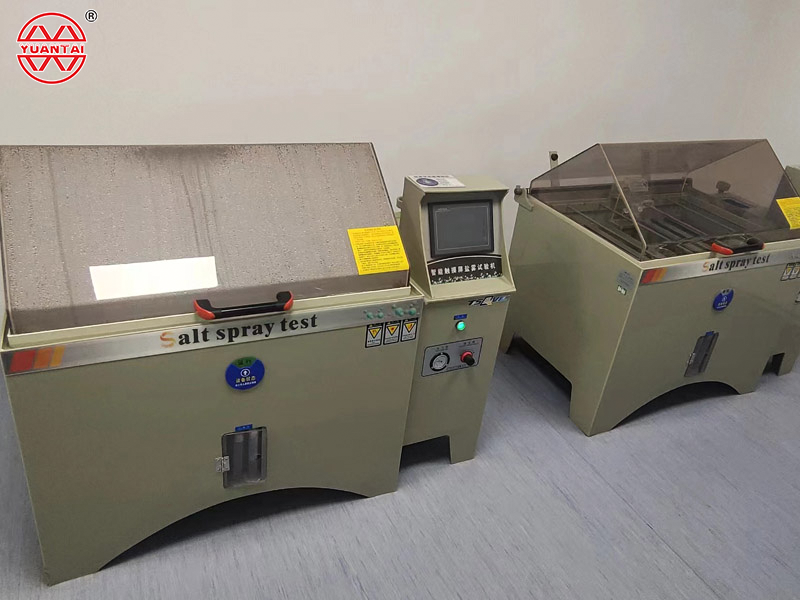
Laboratory salt spray testing chambers used to evaluate and verify the long-term anti-corrosion performance of hot-dip galvanized steel coatings under accelerated atmospheric corrosion simulations.
Secure Port-to-Port Logistics:Operating from Tianjin, we can support bundle packing, container loading, and export documentation coordination according to the agreed trade terms and shipment scope. Risk transfer, customs responsibility, and ocean freight arrangements are handled in line with the applicable Incoterms and contract requirements.