ERW Pipe Sizes & Weight Chart: NPS 1/2–18 in.
- Share
- Issue Time
- Sep 3,2026
Summary
Comprehensive ERW pipe size and weight chart covering NPS 1/2 to 18 inches. View outer diameter, wall thickness (Sch 10 to XXS), and weight per foot/meter for ASTM A53 & API 5L ERW pipes.
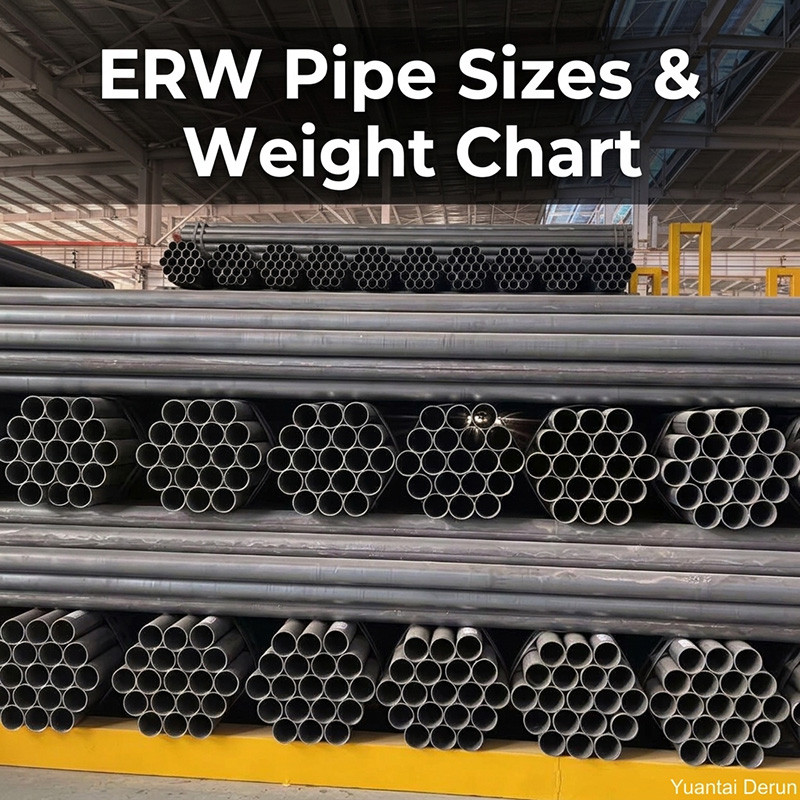
ERW pipe is available in a wide range of nominal sizes and wall thicknesses. This guide covers commonly referenced NPS 1/2 through NPS 18 pipe dimensions and nominal plain-end masses for carbon steel pipe, with standard NPS dimensions referenced to ASME B36.10M.
For example, NPS 2 Schedule 40 pipe has an outside diameter of 60.3 mm (2.375 in.), a nominal wall thickness of 3.91 mm (0.154 in.) and a nominal plain-end mass of approximately 5.44 kg/m (3.66 lb/ft).
The figures in this guide are nominal reference dimensions and plain-end masses. Actual measured mass may differ because of dimensional tolerances, actual material density, length tolerance, coating, end preparation and other purchase-order requirements.
What Is ERW Pipe?
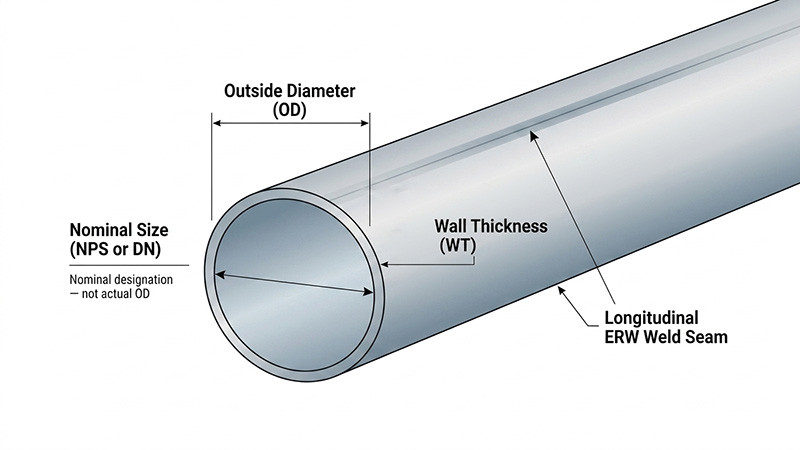
ERW stands for Electric Resistance Welded pipe. It is produced by forming steel strip or coil into a tubular shape and joining the longitudinal seam using electrical resistance heating and pressure.
Many modern ERW pipe mills use high-frequency electric resistance welding. Depending on the manufacturing route, applicable standard and market terminology, products may also be described as ERW pipe, HFW pipe, HF-ERW pipe or high-frequency welded pipe.
After welding, the external weld flash may be removed. Depending on the applicable product standard and production route, the pipe may undergo weld-zone treatment, seam inspection, hydrostatic testing, nondestructive testing or other specified examinations.
ERW identifies a manufacturing method, not a single product standard. A complete pipe specification should also define the applicable standard, grade, dimensions, tolerances, testing requirements, end condition, coating and documentation requirements.
NPS, OD and Schedule: What Do They Mean?
Three terms are commonly used when specifying NPS pipe:
NPS (Nominal Pipe Size): A nominal size designation used in the inch-based pipe dimensional system. It does not necessarily equal the actual outside diameter.
OD (Outside Diameter): The specified outside diameter associated with the applicable dimensional standard.
Schedule: A designation used in the NPS pipe dimensional system to identify a nominal wall thickness for a given NPS.
NPS is a size designation, while OD and wall thickness define the physical pipe dimensions.
For example, NPS 2 pipe has an OD of 60.3 mm under ASME B36.10M. Schedule 40 and Schedule 80 have the same nominal OD but different wall thicknesses:
NPS 2 Sch 40: 3.91 mm
NPS 2 Sch 80: 5.54 mm
For the same NPS and length, increasing wall thickness increases pipe mass and reduces the internal diameter.
For procurement, NPS alone is usually not sufficient. The purchase specification should also identify the applicable product standard, grade, wall thickness or schedule, length, end condition, testing requirements, coating and documentation requirements.
ERW Pipe Size & Weight Chart: NPS 1/2–8
For standard NPS pipe, ASME B36.10M is commonly used as a dimensional reference for welded and seamless wrought steel pipe. The following table shows commonly referenced dimensions and nominal plain-end masses for carbon steel pipe.
| NPS | OD (mm) | OD (in.) | Sch 10 WT (mm) | Sch 40 WT (mm) | Sch 80 WT (mm) | Sch 40 kg/m | Sch 80 kg/m |
| 1/2 | 21.3 | 0.840 | 2.11 | 2.77 | 3.73 | 1.27 | 1.62 |
| 3/4 | 26.7 | 1.050 | 2.11 | 2.87 | 3.91 | 1.69 | 2.20 |
1 | 33.4 | 1.315 | 2.77 | 3.38 | 4.55 | 2.50 | 3.24 |
1-1/4 | 42.2 | 1.660 | 2.77 | 3.56 | 4.85 | 3.39 | 4.47 |
1-1/2 | 48.3 | 1.900 | 2.77 | 3.68 | 5.08 | 4.05 | 5.41 |
2 | 60.3 | 2.375 | 2.77 | 3.91 | 5.54 | 5.44 | 7.48 |
2-1/2 | 73.0 | 2.875 | 3.05 | 5.16 | 7.01 | 8.63 | 11.41 |
| 3 | 88.9 | 3.500 | 3.05 | 5.49 | 7.62 | 11.29 | 15.27 |
3-1/2 | 101.6 | 4.000 | 3.05 | 5.74 | 8.08 | 13.57 | 18.63 |
4 | 114.3 | 4.500 | 3.05 | 6.02 | 8.56 | 16.07 | 22.32 |
5 | 141.3 | 5.563 | 3.40 | 6.55 | 9.53 | 21.77 | 30.97 |
6 | 168.3 | 6.625 | 3.40 | 7.11 | 10.97 | 28.26 | 42.56 |
8 | 219.1 | 8.625 | 3.76 | 8.18 | 12.70 | 42.55 | 64.64 |
All masses are nominal plain-end carbon steel pipe masses in kg/m. They are reference values only and are not acceptance tolerances, shipping weights or guaranteed individual pipe weights.
Large-Diameter ERW Pipe: NPS 10–18
For larger NPS pipe, Schedule 10, Schedule 40 and Schedule 80 provide clearer wall-thickness references than traditional STD and XS designations.
STD (Standard Weight) and XS (Extra Strong) may still appear in older drawings, pipe tables and project specifications. However, their relationship with schedule designations can vary by NPS and should not be assumed without checking the applicable dimensional standard.
For NPS 14 and above, state the required schedule or actual nominal wall thickness directly in the purchase specification.
| NPS | OD (mm) | OD (in.) | Sch 10 WT (mm) | Sch 40 WT (mm) | Sch 80 WT (mm) | Sch 40 kg/m | Sch 80 kg/m |
| 10 | 273.1 | 10.750 | 4.19 | 9.27 | 15.09 | 60.31 | 95.58 |
| 12 | 323.9 | 12.750 | 4.57 | 10.31 | 17.48 | 79.70 | 132.15 |
| 14 | 355.6 | 14.000 | 6.35 | 11.13 | 19.05 | 94.55 | 157.22 |
16 | 406.4 | 16.000 | 6.35 | 12.70 | 21.44 | 123.30 | 181.44 |
18 | 457.2 | 18.000 | 6.35 | 14.27 | 23.83 | 155.06 | 207.18 |
All masses are nominal plain-end carbon steel pipe masses in kg/m. They are reference values only and are not acceptance tolerances, shipping weights or guaranteed individual pipe weights.
How to Calculate ERW Pipe Weight
For a quick theoretical estimate of carbon steel pipe mass, use:
Weight (kg/m) = 0.02466 × t × (D − t)
Where:
D = outside diameter in mm
t = wall thickness in mm
Weight = theoretical pipe mass in kg/m
The coefficient is derived using a carbon steel density of approximately 7,850 kg/m³.
Example: NPS 6 Schedule 40
For NPS 6 Sch 40 pipe:
OD = 168.3 mm
Wall thickness = 7.11 mm
Weight = 0.02466 × 7.11 × (168.3 − 7.11)
Weight ≈ 28.26 kg/m
This matches the nominal plain-end mass for NPS 6 Sch 40 pipe listed in the table.
The formula is useful for estimating non-standard OD × wall-thickness combinations. For standard NPS pipe sizes, however, the applicable dimensional standard should remain the primary reference.
It is important to distinguish among three values:
Theoretical calculated mass: Calculated from nominal dimensions and an assumed material density.
Nominal or tabulated mass: Listed in the applicable dimensional standard or recognized pipe reference table.
Actual measured mass: Determined from the finished pipe and influenced by permitted dimensional tolerances, actual material density, coating, end condition and length.
The 0.02466 coefficient is intended for carbon steel. It should not be used without adjustment for materials with significantly different densities, including stainless steel, duplex stainless steel and aluminium.
Metric ERW Pipe Weight Chart
Metric ERW products are often specified directly by OD × wall thickness instead of NPS and schedule.
The following values are theoretical carbon steel masses in kg/m, calculated from nominal OD and wall thickness using a steel density of approximately 7,850 kg/m³.
| OD (mm) | 2.0 mm | 2.5 mm | 3.0 mm | 4.0 mm | 5.0 mm | 6.0 mm |
21.3 | 0.95 | 1.16 | 1.35 | 1.71 | 2.01 | 2.26 |
26.9 | 1.23 | 1.50 | 2.27 | 2.26 | 2.70 | 3.09 |
33.7 | 1.56 | 1.92 | 2.91 | 2.93 | 3.54 | 4.10 |
42.4 | 1.99 | 2.46 | 3.35 | 3.79 | 4.61 | 5.39 |
| 48.3 | 2.28 | 2.82 | 4.24 | 4.37 | 5.34 | 6.26 |
| 60.3 | 2.88 | 3.56 | 5.41 | 5.55 | 6.82 | 8.03 |
| 76.1 | 3.65 | 4.54 | 6.35 | 7.11 | 8.77 | 10.37 |
88.9 | 4.29 | 5.33 | 8.23 | 8.37 | 10.34 | 12.27 |
114.3 | 5.54 | 6.89 | 8.23 | 10.88 | 13.48 | 16.02 |
139.7 | 6.79 | 8.46 | 10.11 | 13.39 | 16.61 | 19.78 |
168.3 | 8.20 | 10.22 | 12.23 | 16.21 | 20.13 | 24.01 |
219.1 | 10.71 | 13.35 | 15.99 | 21.22 | 26.40 | 31.53 |
273.0 | 13.37 | 16.68 | 19.97 | 26.53 | 33.04 | 39.51 |
323.8 | 15.88 | 19.81 | 23.74 | 31.55 | 39.32 | 47.04 |
Important: These values are theoretical calculated masses based on nominal dimensions and a steel density of approximately 7,850 kg/m³. They are not tabulated values from EN 10255, EN 10219, ASTM A53, API 5L or another product standard.
ERW Pipe Standards and Tolerances
ERW describes a manufacturing process, not a single product standard. The applicable standard depends on the pipe’s intended service, size range, grade, end use and project requirements.
Common examples include
ASTM A53 — Welded and seamless steel pipe for mechanical and pressure applications
ASTM A135 — Electric-resistance-welded steel pipe
API 5L — Line pipe for pipeline transportation systems
EN 10255 — Non-alloy steel tubes suitable for welding and threading
GB/T 3091 — Welded steel pipe for low-pressure fluid service
ASTM A500 — Cold-formed carbon steel structural tubing
EN 10219 — Cold-formed welded structural hollow sections
These standards are not interchangeable. Their requirements may differ in product scope, steel grade, mechanical properties, dimensions, tolerances, testing and inspection.
Structural hollow sections such as ASTM A500 and EN 10219 should also be distinguished from general-purpose pipe standards. A product manufactured to one standard should not automatically be described as complying with another unless the relevant technical requirements have been reviewed and confirmed.
There is no single universal ERW wall-thickness tolerance. The permitted tolerance depends on the governing product standard and purchase specification.
When checking incoming ERW pipe, confirm:
Nominal wall thickness
Permitted wall-thickness tolerance
Minimum required wall thickness
OD tolerance
Ovality requirements
Applicable product standard
Required testing and inspection
For pressure or structural calculations, nominal wall thickness should not automatically be treated as the minimum actual wall thickness.
ASME B36.10M vs. EN Dimensions
ASME B36.10M and European product standards use different dimensional systems.
For example, NPS 1 under ASME B36.10M has an OD of 33.4 mm, while some European pipe and tube ranges use nearby metric dimensions, such as 33.7 mm.
This difference can become important when selecting:
Fittings
Mechanical couplings
Grooved connections
Threaded components
Replacement pipe
Inspection gauges
EN 10219 is not a direct European equivalent of ASME B36.10M. EN 10219 specifies requirements for cold-formed welded structural hollow sections, while ASME B36.10M provides dimensional information for welded and seamless wrought steel pipe.
When dimensional compatibility matters, specify the actual OD and wall thickness together with the governing product standard rather than relying on NPS alone.
Frequently Asked Questions
Q:Does ERW Pipe Have a Welded Seam?
Yes. ERW pipe has a longitudinal welded seam where the edges of the formed steel strip are joined. Seam examination and testing requirements depend on the applicable product standard and purchase specification.
q:What Is the OD of NPS 2 Pipe?
NPS 2 pipe has an OD of 60.3 mm (2.375 in.) under ASME B36.10M.
Q:How Much Does NPS 2 Sch 40 ERW Pipe Weigh?
The nominal plain-end mass is approximately 5.44 kg/m (3.66 lb/ft).
Q:What Is the Difference Between Schedule 40 and Schedule 80?
For the same NPS, Schedule 80 generally has a thicker nominal wall than Schedule 40. This increases pipe mass and reduces the internal diameter while the nominal OD remains the same.
For larger NPS pipe, traditional STD and XS designations may not correspond directly to Schedule 40 and Schedule 80. State the required schedule or nominal wall thickness clearly when ordering.
q:Can ERW Pipe Weight Be Calculated From OD and Wall Thickness?
Yes. A commonly used theoretical calculation for carbon steel pipe is:
Weight (kg/m) = 0.02466 × t × (D − t)
Use D and t in millimetres.
For standard NPS pipe, the applicable dimensional standard should remain the primary reference.
Q:Does ERW Pipe Have a Universal Pressure Rating?
No. Pressure capability depends on material grade, minimum wall thickness, design temperature, fluid service, corrosion allowance, applicable design code, weld-quality requirements and project-specific conditions.
A schedule designation alone should not be treated as a pressure rating.
Conclusion
ERW pipe sizing becomes easier once NPS, OD, wall thickness and schedule are understood.
NPS is a nominal designation. OD is the specified outside diameter within the applicable dimensional system, while the schedule or another wall designation identifies nominal wall thickness. Changing wall thickness affects internal diameter, pipe mass and may affect the suitability of the pipe for a particular pressure, mechanical or structural application.
For standard NPS pipe, ASME B36.10M is commonly used as a dimensional reference for welded and seamless wrought steel pipe. It should not be assumed that the same NPS schedule dimensions apply to EN 10255, EN 10219 or other product standards.
For non-standard metric OD × wall-thickness combinations, the theoretical weight formula provides a useful estimate. For standard NPS pipe sizes, use the applicable dimensional standard as the primary reference.
For procurement, clearly specify the nominal size or actual OD, wall thickness or schedule, length, product standard, grade, testing, end condition, coating and documentation requirements.
Looking for ERW pipe in a specific size or grade? Send us your required OD, wall thickness, length, standard and grade. Our team can help confirm applicable dimensions, tolerances, testing requirements and estimated pipe weight.