Engineering Guide to Carbon Steel Rockwell Hardness
- Share
- Issue Time
- Jan 20,2026
Summary
In the metallurgy and manufacturing industries, Rockwell hardness (HR) stands as the most critical non-destructive (or micro-destructive) test for verifying the structural integrity and heat-treatment success of carbon steel. Unlike laboratory-heavy methods, the Rockwell test is designed for the shop floor—providing fast, repeatable, and direct-reading data that informs critical engineering decisions.
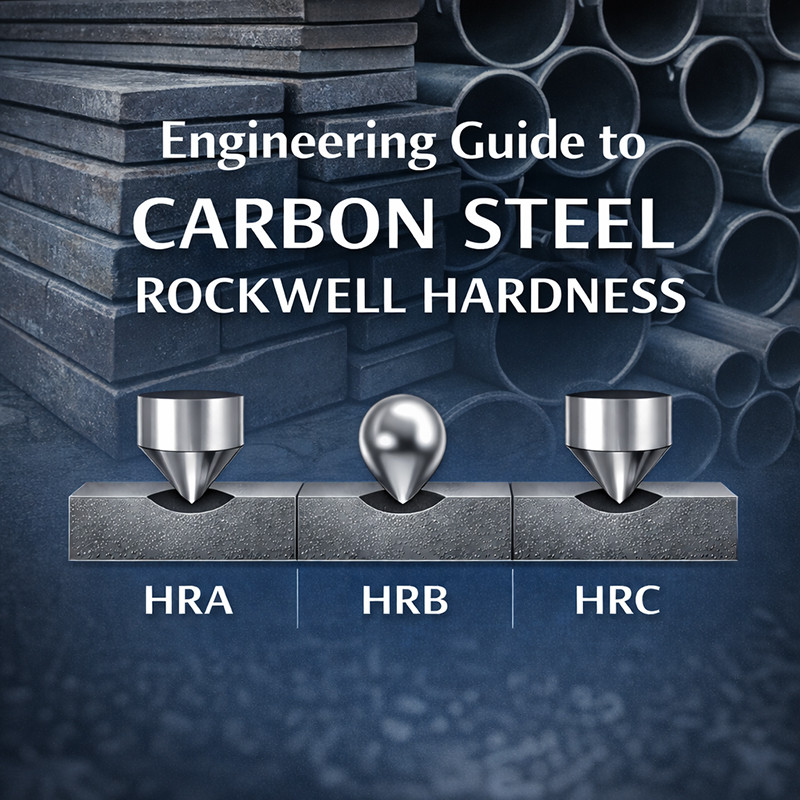
Engineering Guide to Carbon Steel Rockwell Hardness
In the metallurgy and manufacturing industries, Rockwell hardness (HR) stands as the most critical non-destructive (or micro-destructive) test for verifying the structural integrity and heat-treatment success of carbon steel. Unlike laboratory-heavy methods, the Rockwell test is designed for the shop floor—providing fast, repeatable, and direct-reading data that informs critical engineering decisions.
The Physics of the Indentation
The core of the Rockwell method is the measurement of incremental depth rather than the surface area of the mark left behind. This distinguishes it from Brinell or Vickers testing, which requires optical measurement of the indentation diameter.
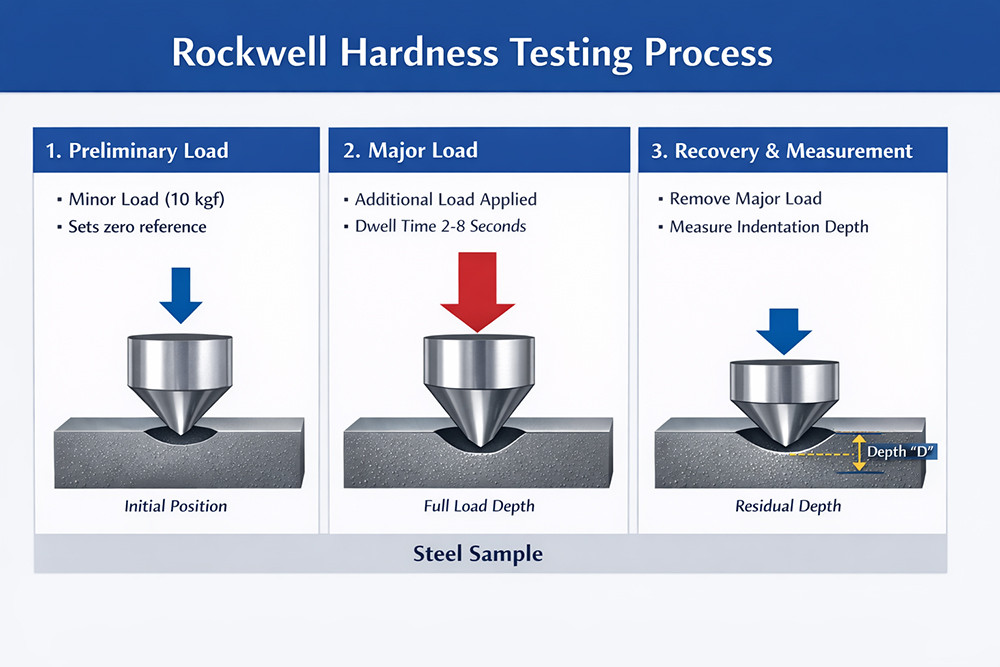
The test follows a specific mechanical sequence:
Preliminary Loading: A minor load (usually 10 kgf) is applied to the indenter. This "seats" the indenter, breaking through surface oxidation or minor roughness to establish a stable zero-reference position.
Major Loading: An additional load is applied for a specific dwell time (usually 2 to 8 seconds). This forces the indenter to its maximum depth of plastic deformation.
Recovery and Measurement: The major load is removed, but the minor load remains. The machine measures the difference between the initial zero-point and the final position of the indenter.
In this system, one Rockwell hardness point corresponds to a vertical movement of 0.002 mm (2 microns). This level of precision allows engineers to detect even subtle variations in a steel’s tempered state.
Technical Breakdown: HRA, HRB, and HRC
Carbon steel exists in various states—from soft, low-carbon sheets to brittle, high-carbon tool steels. Using a single scale for all would lead to inaccurate data or equipment damage.
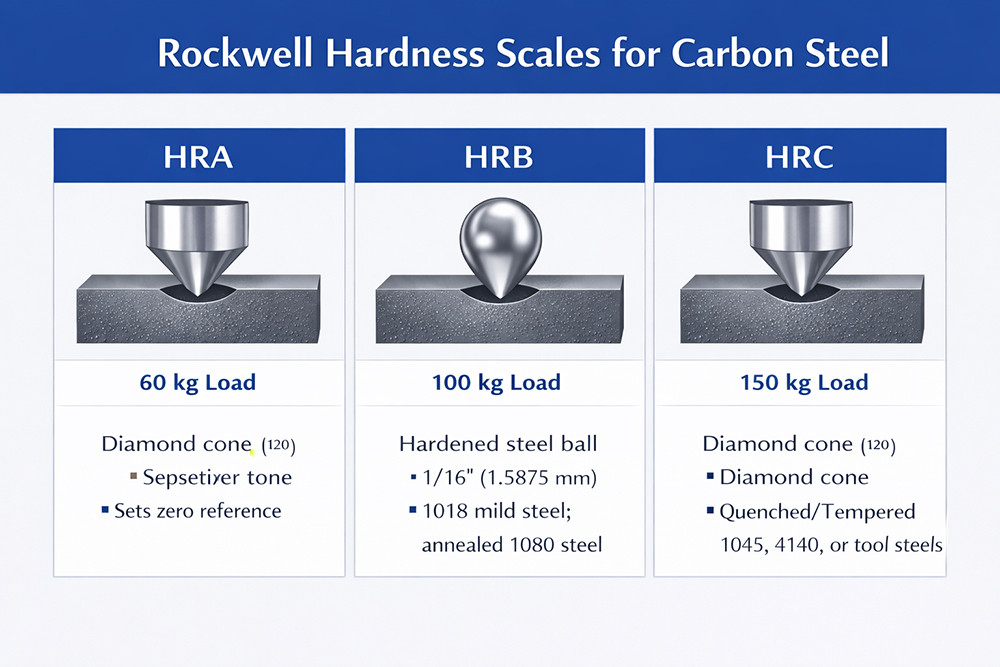
HRA Scale (60 kg Load / Diamond Cone)
The A-scale uses the lightest load among the primary scales. It is typically reserved for thin-gauge carbon steel strips or parts with a very thin case-hardened layer. Because the diamond cone is used, it can measure extremely hard materials without the indenter deforming, but the low load prevents the indenter from "punching through" thin samples.
HRB Scale (100 kg Load / 1/16" Steel Ball)
This is the standard for mild steel, hot-rolled structural sections, and annealed medium-carbon steel. Since the indenter is a hardened steel ball, it covers the "softer" end of the spectrum.
Practical Limit: If a material’s hardness exceeds HRB 100, the steel ball itself may begin to flatten under the pressure, leading to inaccurate, lower-than-actual readings. At this point, a transition to HRC is mandatory.
HRC Scale (150 kg Load / 120° Diamond Cone)
HRC is the most discussed scale in mechanical engineering. It is the benchmark for hardened and tempered carbon steels. If a part has undergone quenching, its hardness is almost exclusively measured on the C-scale.
Range Note: HRC is generally considered reliable between 20 and 70. Values below HRC 20 are inconsistent because the diamond cone penetrates too deeply for accurate calibration.
| Scale | Indenter | Load | Typical Carbon Steel Grade/State |
| HRA | Diamond | 60kg | Surface-hardened 1045 steel; thin shim stock. |
| HRB | 1/16" Ball | 100kg | 1018 mild steel; annealed 1080 steel. |
| HRC | Diamond | 150kg | Quenched/Tempered 1045, 4140, or tool steels. |
Critical Constraints: Geometry and Thickness
A common failure in quality control is ignoring the "edge effect" or the "anvil effect." To obtain a valid Rockwell reading, the sample must meet two strict criteria:
The 10:1 Thickness Rule: The material must be at least ten times thicker than the depth of the indentation. If the test leaves a "shiny spot" or a bulge on the underside of the sample, the reading is skewed by the hardness of the testing machine's anvil, not the steel itself.
Spacing Requirements: Indentations must be spaced at least three diameters apart from each other and from the edge of the sample. Testing too close to a previous mark measures "work-hardened" metal, resulting in an artificially high reading.
Hardness vs. Strength: The Design Trade-off
In technical discussions, hardness and tensile strength are often conflated, but they represent different physical behaviors.
Hardness is a surface-level resistance to localized pressure and abrasion. It correlates well with wear resistance. Strength (Tensile or Yield) is the bulk material's ability to resist deformation under a load.
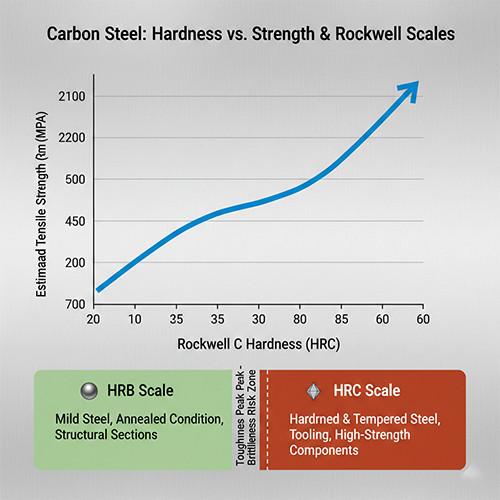
For carbon steels, there is a reliable empirical correlation: as hardness increases, tensile strength typically increases. For example, a steel with a hardness of HB 300 (roughly HRC 32) will have an approximate tensile strength (Rm) of 1000 MPa.
However, the "cost" of high hardness is ductility. As you move from HRB 80 to HRC 60:
Wear resistance goes up significantly.
Tensile strength goes up.
Fracture toughness drops sharply.
Brittleness increases, making the part prone to catastrophic failure under shock loads.
Final Practical Considerations
When selecting carbon steel based on Rockwell values, the "hardest" steel is rarely the best choice for structural applications. For instance, a 1045 carbon steel bolt hardened to HRC 55 might seem superior because of its strength, but it lacks the ability to "stretch" before breaking. In a high-vibration environment, that bolt may snap, whereas a bolt tempered to a more moderate HRC 30 would survive by slightly deforming.
Summary
Use HRB for raw materials and structural steel in their "as-supplied" or annealed state.
Use HRC to verify the success of heat treatment (quenching and tempering).
Always verify that your sample thickness supports the load to avoid "false-positive" hardness readings.