GB/T 6728-2025 Guide: Free Multilingual PDF Downloads
- Share
- Issue Time
- Jun 22,2026
Summary
The new GB/T 6728-2025 standard is officially active, replacing the 2017 edition. Authored by drafting participant Yuantai Derun, this guide breaks down core revisions: consolidated 6728+6723 frameworks, new laser cutting & mechanical property requirements, and revised Appendix B tolerances & galvanizing re-inspection rules. Get free PDF downloads of the official Chinese, English, and bilingual texts, plus grade mapping to EN 10219 & ASTM A500.
Quick View
| Item | Information |
| Standard | GB/T 6728-2025 |
| Effective Date | March 1, 2026 |
Replaces | GB/T 6728-2017 |
Scope | Cold-formed sections |
Language | Chinese / English |
Drafting Organization | Yuantai Derun |
Let’s face it—whenever China updates its steel standards, international procurement falls into a temporary chaos. On March 1, 2026, the old 2017 version was officially scrapped, and GB/T 6728-2025 took over the entire cold-formed structural steel market.
If you are currently managing an active project or bidding for a global EPC contract, this isn't just a minor regulatory change on paper. It means your old structural calculations, material submittals, and tolerance allowances are officially outdated. Your overseas clients are probably blowing up your inbox right now, asking if their current blueprints are still valid.
Don't panic. Instead of digging through hundreds of pages of messy technical text, read this quick, blunt briefing. We’ve broken down exactly what changed under the hood, the key international grade mappings, and where to download the complete Chinese, English, and bilingual reference PDFs without paying a dime.
Yuantai Derun as a Drafting Organization of GB/T 6728-2025
Yes, our name appears in the official drafting committee list.Open up the official GB/T 6728-2025 document, skip to the preamble page, and look at the drafting committee. Tianjin Yuantai Derun Steel Pipe Manufacturing Group Co., Ltd. is right there, black on white.
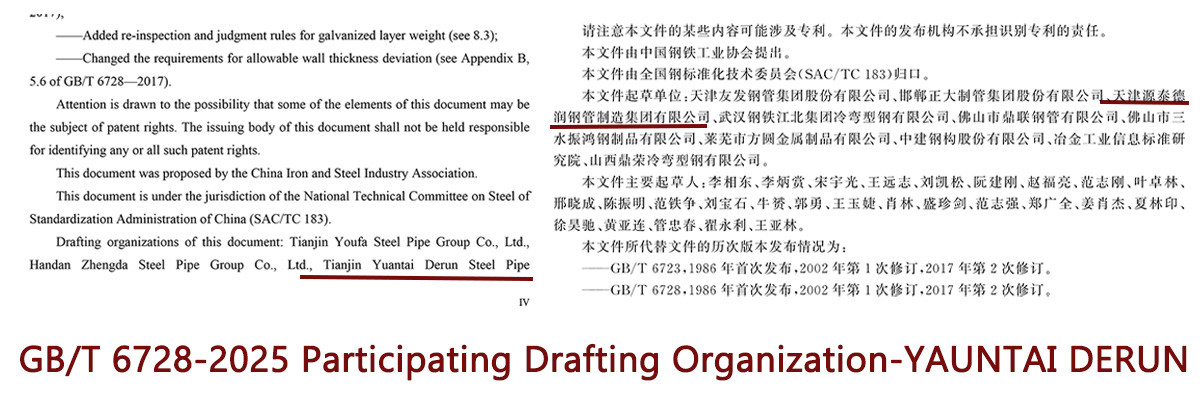
We aren't just a mill that reads the rules; we are the ones who helped write them.
Why should you care? Because during the multi-year drafting phase, our engineers didn't just sit in an office. We took actual fabrication data from our million-ton square and rectangular tube lines, combined it with real-world feedback from international job sites, and fought to bridge the gap between Chinese domestic manufacturing and western engineering codes like EN 10219 or ASTM A500. We pushed for tighter, more practical metrics because we know how frustrating it is when a delivered batch doesn't fit the weld prep on site.
GB/T 6728-2025 vs GB/T 6728-2017: What Changed?
This 2025 update is a major structural overhaul. The committee did something long overdue: they merged the old GB/T 6728 (structural hollow sections) and GB/T 6723 (cold-formed open profiles) into one unified framework.
To give you a clearer picture without making you read through the entire regulatory textbook, our engineering team put together this quick, no-nonsense comparison table based strictly on the revised official clauses:
Key Technical Shifts: GB/T 6728-2017 vs. GB/T 6728-2025
| Technical Parameter | Old Standard (2017 Edition) | New Standard (2025 Edition) | What It Actually Means For Your |
| Framework Scope | Fragmented. GB/T 6728 for hollow sections; GB/T 6723 for open profiles. | Consolidated. One unified standard for cold-formed steel profiles. | Much cleaner material submittal and Much cleaner material submittal and faster approval during foreign engineering audits. |
| Mechanical Property Requirements | Standard baselines for tension and yield tracking. | Expanded mechanical criteria. Additional testing and property requirements introduced. | Higher structural predictability. Provides structural engineers with more comprehensive material data for load designs. |
| Laser Cutting Requirements | No explicit technical provisions for advanced post-processing. | Newly added. Specific material criteria and guidelines for laser cutting suitability. | Simplifies downstream fabrication. Ensures the hollow sections meet precision requirements for modern automated laser cutting lines. |
Wall Thickness Allowance (Δt) | Broad tolerance window. Minor wall-thinning at heavy corners was common. | Strictly modified (Appendix B). Narrower, re-segmented variance limits. | Enhanced cross-sectional uniformity across the entire profile profile. |
Galvanizing Requirements & Re-inspection | General coating guidelines. Lacked concrete re-inspection protocols. | Modified galvanizing clauses & added Section 8.3 re-inspection rules. | Rigid batch-level compliance checks. Guarantees the zinc layer conforms uniformly to the stated technical specifications before delivery. |
Overall, the revision introduces tighter dimensional control and broader technical coverage.
GB/T 6728-2025 Equivalent EN 10219 and ASTM A500 Grades
How to Match Your Specifications?When your overseas client sends over a drawing specified in European or American standards, your technical team needs to map those chemical and mechanical properties instantly. The 2025 edition streamlines this cross-referencing process.
Here is the quick-lookup material mapping table we use internally at Yuantai Derun to guide international EPC bids:
International Steel Grade Mapping Guide
| Structural Application | Legacy Chinese Grade (2017) | New Standard Grade (2025 Edition) | Equivalent European Code (EN 10219) | Equivalent American Code (ASTM A500) |
| Light Structural / Purlins | Q235B | Q235B | S235JRH | Grade A / Grade B |
| Standard Structural / Bridges | Q355B / Q355C | Q355B / Q355C | S355J0H | Grade C |
| Heavy-Duty Wind & Seismic | Q355D / Q355E | Q355D / Q355E | S355J2H / S355K2H | Grade D (Custom Spec) |
High-Strength / Low-Weight | Q420 / Q460 | Q420 / Q460 | S420MH / S460MH- | - |
Quick Note on Yield Strength: The 2025 edition maintains strict alignment on upper yield strength values (ReH), meaning if your structural calculation model requires a minimum yield of 355 MPa, the transition to the new 2025 batch won't mess up your load-bearing simulations.
The listed EN and ASTM grades are approximate engineering equivalents intended for general reference. Final material selection should be verified according to the project specification.
Inside Appendix B: The Exact Wall Thickness Tolerances (Δt)
Let's look at the real data that everyone is searching for. Under the old 2017 text, the tolerance window for cold-formed welded tubes was broader, which occasionally led to discussions during third-party inspections at the port.
GB/T 6728-2025 Appendix B systematically revises this by tightening the allowable deviations. Here is a snapshot of how the technical framework handles thickness control for structural hollow sections:
· For Light-Gauge Thickness Ranges:
Old 2017 Edition: Allowed wider percentage-based variances that could cause noticeable deviations at critical structural points.
New 2025 Edition: Enforces tighter, rigid metric limits based on updated mill capability classifications. This ensures that the nominal cross-sectional area remains stable, preventing unexpected localized thinning.
· For Heavy-Gauge Thickness Ranges:
Old 2017 Edition: Permissible deviations varied widely depending on the total profile perimeter, complicating alignment during splicing.
New 2025 Edition: Introduces structured, precise segmented caps (detailed fully in the Appendix B data tables). The variation window is locked down to guarantee consistent material distribution under axial and bending loads.
For your international procurement contracts, this means you can confidently assure your client’s quality inspector that the manufacturing tolerances strictly follow the tight, updated limits set out in the 2025 text.
Material Certificates and Compliance Documentation
Beyond the dimensional tighter limits in Appendix B, GB/T 6728-2025 reshapes how material compliance is documented for global markets. If you are bidding for a high-stakes infrastructure contract, your material submittal package needs to look as professional as your engineering blueprints.
The updated requirements place greater emphasis on consistent material verification and supporting inspection records.For every batch of hollow sections produced under the new code, the MTC includes verifiable chemical heat analysis and specific mechanical test data that can be cross-verified instantly.
When preparing your technical presentation for overseas consultants, don’t just send a generic catalog. Pair the English reference translation with your batch MTC data.This can help reduce additional review requests or repeated material verification.
GB/T 6728-2025 PDF Download
Finding official, clean copies of Chinese technical regulations online is usually a nightmare of paywalls and sketchy links. Because we helped draft this code, Yuantai Derun has made the technical reference files open-access for global engineers and trade partners.
Grab what you need below—no registration, no strings attached:
FAQ
Q:Is GB/T 6728-2017 still valid?
A:No. GB/T 6728-2025 officially replaced the 2017 edition on March 1, 2026.
Q:Is there an official English version?
A:No official English version has been publicly issued. Reference translations may be used for engineering communication.
Q:Is Q355B equivalent to S355J0H?
A:They are commonly regarded as approximate equivalents, but project specifications should always govern material selection.
Q:Does GB/T 6728 cover galvanized tubes?
A:The standard includes relevant coating inspection requirements, while galvanizing specifications may require additional standards.
Need Technical Support?
✓ Grade equivalency
✓ EN 10219 comparison
✓ ASTM A500 comparison
✓ MTC review
✓ Project recommendations
Contact YUATAI DERUN GROUP