Hardness vs. Hardenability: A Guide for Steel Tube Procurement
- Share
- Issue Time
- Mar 13,2026
Summary
Understanding the tension between these two properties is the difference between a project that stands the test of time and one that fails during fabrication. Let’s break down the real-world difference between these two metallurgical giants.
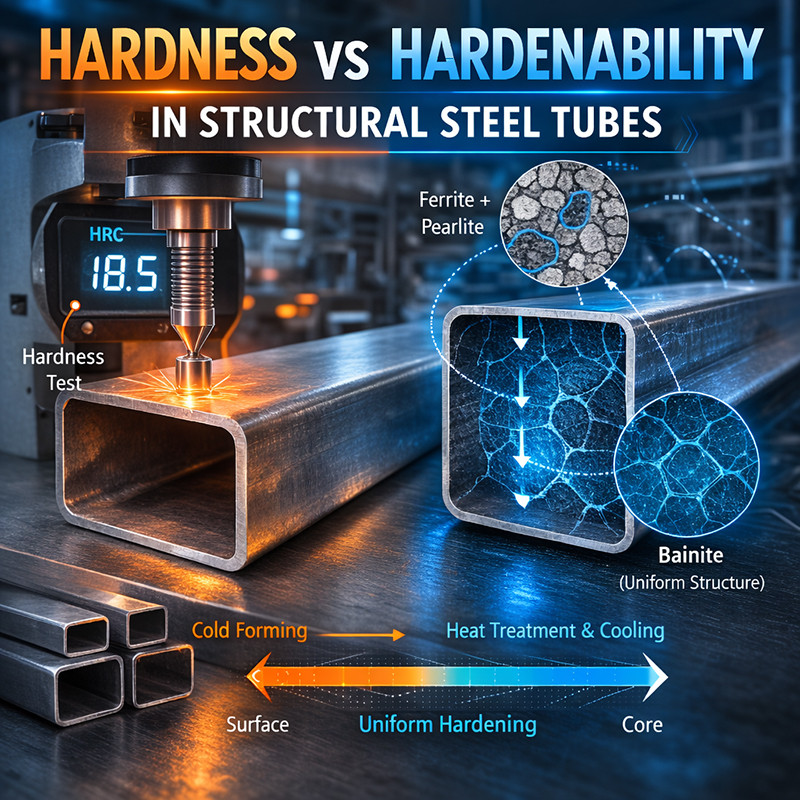
If you have been in the steel industry for more than a few months, you have likely heard suppliers or engineers use the terms "Hardness" and "Hardenability" as if they were the same thing. They aren't. In fact, mistaking one for the other is a common—and expensive—mistake made during the procurement of square and rectangular steel tubes (SHS/RHS).
Imagine ordering a batch of heavy-duty structural tubes for a high-rise foundation or a massive crane arm. On paper, the surface hardness looks perfect. But when your team starts welding or the structure is put under load, cracks appear or the material deforms in the center. Why? Because while the "skin" was tough, the "inner muscle" wasn't there.
Understanding the tension between these two properties is the difference between a project that stands the test of time and one that fails during fabrication. Let’s break down the real-world difference between these two metallurgical giants.
Hardness: The "Surface Armor"
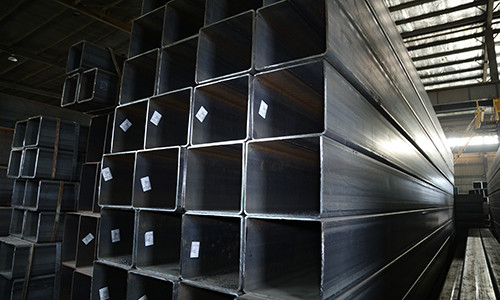
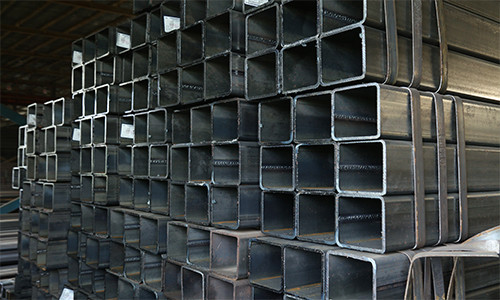
Hardness is the most intuitive property of steel. It is a measure of how well the metal surface resists being dented, scratched, or worn away. When you think of the teeth on a bucket loader or the surface of a conveyor pipe, you are thinking about hardness.
In the world of carbon steel, hardness is almost entirely driven by Carbon. The more carbon you have in the steel, the harder it can become after it is heated and rapidly cooled (quenched). However, there is a trade-off: as hardness goes up, ductility (the ability to bend without breaking) goes down.
●The Measurement : You’ll see this on your Mill Test Certificate (MTC) expressed as HRC (Rockwell), HB (Brinell), or HV (Vickers).
●The Analogy : Think of a glass bottle. It is incredibly hard on the surface—you can’t easily scratch it with a fingernail—but if you hit it with a hammer, it shatters. It has high hardness but lacks internal toughness.
Hardenability: The "Inner Muscle"
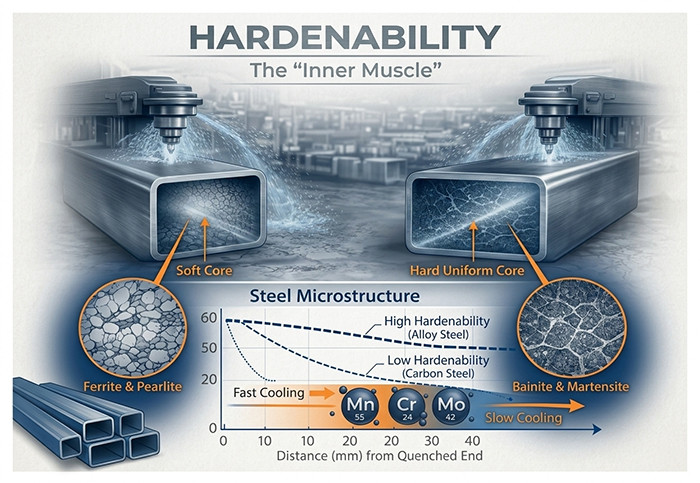
This is where many buyers get lost. Hardenability is not about how hard the steel is right now; it’s about how deep that hardness can penetrate into the center of the material during the cooling process.
When a thick-walled steel tube (20mm or 40mm thick) is quenched, the outside cools instantly because it is in direct contact with the water or oil. But the inside? The heat has to travel through the thickness of the steel to get out. If the steel has low hardenability, the center stays hot for too long. By the time it finally cools, it has transformed into a soft, weak structure.
If the steel has high hardenability, the entire wall—from the outer skin to the very core—transforms into a strong, uniform structure.
●The Science: This is driven by Alloys. Manganese (Mn), Chromium (Cr), and Molybdenum (Mo) are the "magic ingredients" that shift the steel's cooling curves, allowing the strength to reach the center even if the cooling is slow.
●The Measurement: Engineers use the Jominy End-Quench Test. They cool one end of a steel bar and measure the hardness at different distances from that end. A flat line on the chart means the steel has great hardenability.
●The Analogy: Imagine two loaves of bread. One is a baguette with a rock-hard crust but a soft, airy middle. The other is a dense, artisanal sourdough that is firm and consistent from the crust to the very center. The sourdough has higher "hardenability."
The Great Conflict: Weldability vs. Depth
Here is the catch that every project manager needs to know: High hardenability is a double-edged sword.
In the construction of square and rectangular tubes, we often weld these components to form massive frames. If your steel has very high hardenability, the area right next to the weld (the Heat Affected Zone or HAZ) will try to get "too hard, too fast" as it cools down from the heat of the welding torch.
This creates a brittle zone that is prone to "cold cracking." To manage this, we use the Carbon Equivalent Value (CEV) formula. It tells us how much the alloys are contributing to the hardenability:

If your CEV is over 0.45%, you usually need to pre-heat the steel before welding. This slows down the cooling and prevents that brittle "glass-like" zone from forming.
Why Your Choice of Standard Matters (ASTM vs. EN)
When sourcing internationally, you'll see different approaches to these properties.
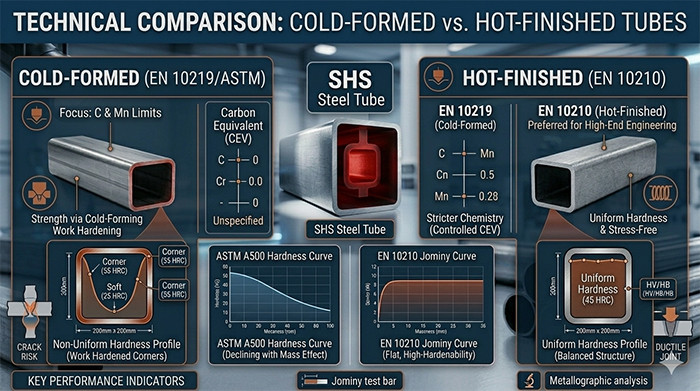
●ASTM A500: This is the standard for North American structural projects. It focuses on the basics—Carbon and Manganese limits—to ensure the tubes are strong enough for buildings but still easy to weld. It relies on the "work hardening" of cold-forming to get its strength.
●EN 10210 / 10219: These European standards are often much stricter about chemistry. They explicitly limit the CEV to ensure that if you buy an S355 grade tube, you know exactly how it will behave under a welding torch, regardless of how thick the wall is.
For high-end engineering, the Hot-Finished (EN 10210) tube is often preferred because the heating process removes the internal stresses found in cold-formed tubes, providing a much more uniform hardness across the entire cross-section.
FAQ
Can I increase the hardness of my steel tubes without changing the chemistry?
Yes, but through Cold-Forming. When square tubes are bent into shape from a round pipe while cold (like ASTM A500 Grade B), the metal undergoes "strain hardening." This makes the corners (the R-angle) significantly harder and stronger than the flat sides. However, this isn't "hardenability"—it's a mechanical change that makes the corners slightly more brittle and sensitive to stress.
Why did my thick-walled tube fail the strength test at its core?
This is a classic "Mass Effect" failure. If you use a steel with low hardenability for a very thick wall (like 30mm+), the center of the wall simply doesn't cool fast enough to transform into the strong microstructure you need. For heavy-section engineering, you must specify a material with micro-alloys to ensure the strength is consistent all the way through the wall.
Is it possible for a steel tube to be too hard?
Absolutely. In structural engineering, if a tube is too hard, it loses its Ductility. In an earthquake or under heavy wind loads, you want the steel to be able to bend slightly without snapping. Steel that is "too hard" will simply snap like a dry twig. This is why building codes have a "maximum" tensile strength limit, not just a minimum.
How does the "R-Angle" affect hardness in welding?
The corners of a square tube are already the hardest part due to the cold-forming process. If you weld too close to a sharp corner on a high-hardenability steel, you are adding heat to an already stressed area. This is a recipe for "toe cracks." Quality manufacturers like Yuantai Derun ensure the R-angle is precisely controlled to minimize this risk.
Does high "Hardness" guarantee better wear resistance?
Generally, yes. If you are building a coal chute or a gravel conveyor using steel tubes, high surface hardness prevents the abrasive material from "eating" the steel. But remember, if that chute also needs to take heavy impacts, you need the "inner muscle" of hardenability to keep the entire tube from cracking under the pressure of the falling rocks.