How to Choose Steel Pipe Size and Schedule
- Share
- Issue Time
- Sep 22,2026
Summary
NPS is not the OD, and schedule is not a pressure rating. Learn how steel pipe size, wall thickness, and schedule work — with charts and formulas.
Ordering steel pipe sounds straightforward until the details start to matter.
A buyer may ask for “2-inch pipe” or “Schedule 40 pipe,” but neither description is enough on its own. A proper specification normally includes the pipe size, wall thickness or schedule, material grade, length, end preparation, coating, inspection requirements, and the applicable standard.
The two points that cause the most confusion are simple:
NPS is usually not the actual outside diameter.
Schedule is not a pressure rating.
Once those are understood, reading a pipe specification becomes much easier.
Quick Answer: NPS, DN, OD and Schedule
Steel pipe sizing is built around a few related terms:
NPS means Nominal Pipe Size. It identifies the standard pipe-size series.
DN means Nominal Diameter. It is the metric designation commonly used alongside NPS.
OD means Outside Diameter. For a given NPS, the nominal OD is set by the applicable dimensional standard.
Schedule, often written as SCH, identifies a wall-thickness series for that NPS.
For the same NPS, a higher schedule generally means:
A thicker wall
A smaller inside diameter
A lower internal flow area
More steel per metre
A higher theoretical pipe mass
A simple way to look at it is:
NPS / DN → nominal size → OD → wall thickness → ID → flow area → pipe weight
For standard carbon-steel pipe, ASME B36.10M is commonly used as the dimensional reference for NPS, OD, wall thickness, and theoretical weight. The material standard still depends on the project, service conditions, and customer specification.
What Is the Actual Size of a 2-Inch Steel Pipe?
In most cases, “2-inch steel pipe” means NPS 2. It does not mean the pipe has a 2-inch outside diameter.
NPS 2 pipe has a nominal outside diameter of:
60.3 mm
2.375 in
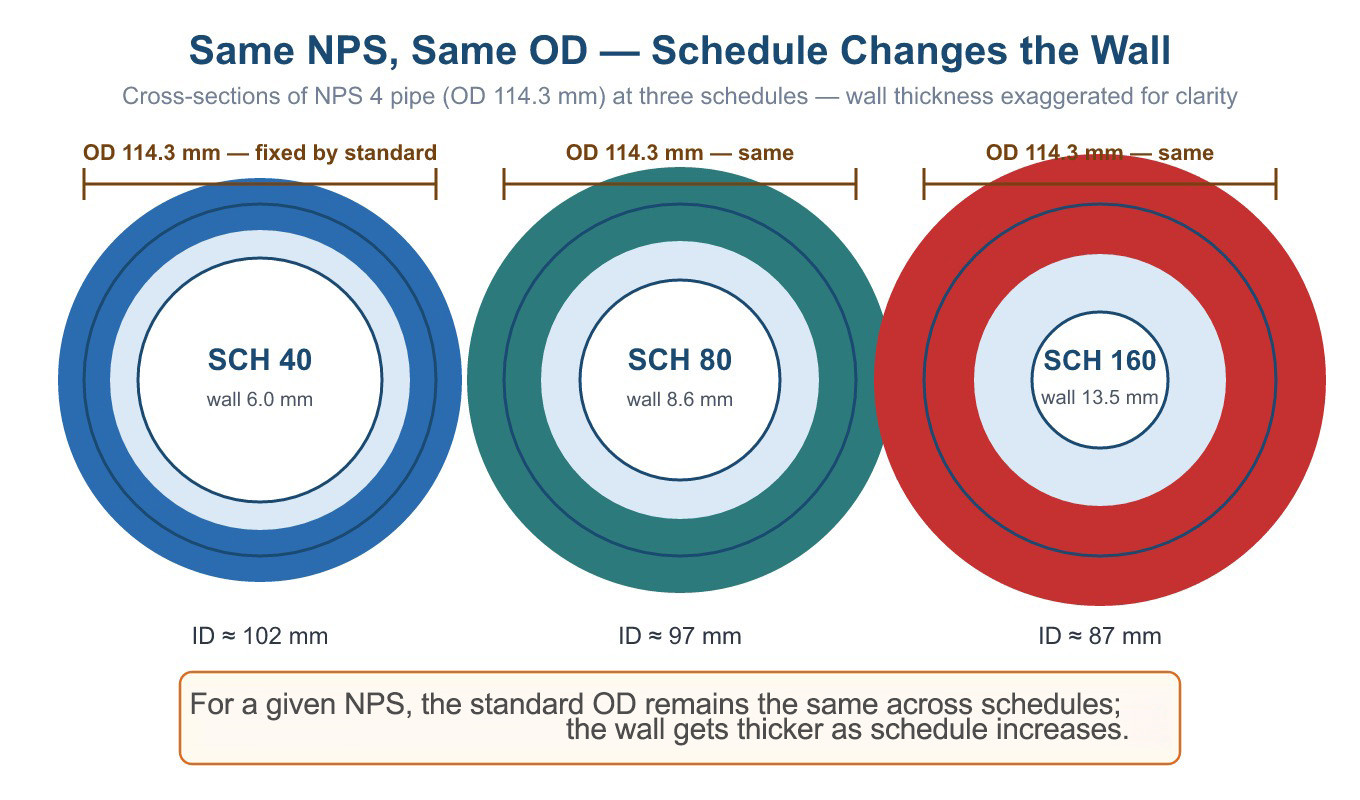
That OD remains the same whether you choose SCH 40 or SCH 80. The difference is the wall thickness.
| NPS 2 Pipe | Nominal Wall Thickness | Approximate Inside Diameter |
| SCH 40 | 3.91 mm | 52.5 mm |
| SCH 80 | 5.54 mm | 49.2 mm |
SCH 80 has the same OD as SCH 40, but a thicker wall. That leaves less room inside the pipe.
The same pattern applies across common pipe sizes:
· NPS 4 has a nominal OD of 114.3 mm
· NPS 6 has a nominal OD of 168.3 mm
· NPS 8 has a nominal OD of 219.1 mm
Is D N50 the Same as a 50 mm Outside Diameter?
No.
DN50 generally corresponds to NPS 2, which has a nominal OD of 60.3 mm. DN is a nominal size label. It should not be read as the actual OD in millimetres.
This is one reason it is important to state both the nominal size and the required wall thickness when requesting a quote.
Steel Pipe Size and Schedule Chart
The table below shows commonly referenced dimensions for carbon-steel pipe. It is useful for early selection, quotation checks, and weight estimates.
Before placing an order, always confirm the applicable standard edition, customer specification, wall-thickness tolerance, and project requirements.
| NPS | DN | Nominal OD (mm) | SCH 40 Nominal WT (mm) | SCH 80 Nominal WT (mm) | SCH 40 Theoretical Mass (kg/m) |
| 1/2 | DN15 | 21.3 | 2.77 | 3.73 | 1.27 |
| 3/4 | DN20 | 26.7 | 2.87 | 3.91 | 1.68 |
| 1 | DN25 | 33.4 | 3.38 | 4.55 | 2.50 |
1-1/2 | DN40 | 48.3 | 3.68 | 5.08 | 4.05 |
2 | DN50 | 60.3 | 3.91 | 5.54 | 5.44 |
3 | DN80 | 88.9 | 5.49 | 7.62 | 11.29 |
4 | DN100 | 114.3 | 6.02 | 8.56 | 16.07 |
6 | DN150 | 168.3 | 7.11 | 10.97 | 28.26 |
8 | DN200 | 219.1 | 8.18 | 12.70 | 42.55 |
The mass figures above are theoretical plain-end values. They are useful for estimating steel consumption, freight, and container loading, but they should not be treated as guaranteed shipment weights.
Actual shipment mass can vary because of permitted tolerances, pipe length, bevels, threads, couplings, galvanizing, coating, packing materials, and bundle configuration.
What Does Pipe Schedule Mean?
Pipe Schedule tells you the wall-thickness series for a particular NPS. It does not identify the material grade, and it does not establish a safe working pressure by itself.
For example, NPS 2 pipe has the same nominal OD whether it is SCH 40 or SCH 80:
· NPS 2 SCH 40: 60.3 mm OD × 3.91 mm wall
· NPS 2 SCH 80: 60.3 mm OD × 5.54 mm wall
The thicker SCH 80 wall reduces the inside diameter.
Does SCH 80 Have a Larger Diameter Than SCH 40?
No.
For the same NPS, SCH 40 and SCH 80 have the same nominal OD. SCH 80 is heavier because it has a thicker wall, not because it has a larger outside diameter.
STD, XS and XXS: What Do They Mean?
STD, XS, and XXS are traditional wall-thickness descriptions that are still common in drawings, RFQs, and older specifications.
| Designation | Meaning |
| STD | Standard Weight |
| XS | Extra Strong |
| XXS | Double Extra Strong |
In common practice:
STD generally corresponds to SCH 40 for NPS 10 and smaller.
XS generally corresponds to SCH 80 for NPS 8 and smaller.
XXS is a separate heavy-wall series and should not be assumed to match a specific schedule.
These terms should not be treated as universal equivalents. If the drawing specifies STD, XS, or XXS, confirm the actual required wall thickness against the applicable dimensional standard before ordering.
Does SCH 80 Mean Higher Pressure?
Not automatically.
For the same NPS, SCH 80 normally has a thicker wall than SCH 40. A thicker wall can improve pressure capability, but Schedule is still not a pressure class.
The allowable pressure of a pipe system depends on more than wall thickness. Important factors include:
Design pressure and design temperature
Pipe material grade
Allowable stress at operating temperature
Pipe OD and wall thickness
Corrosion allowance
Permitted manufacturing tolerances
Pipe manufacturing method
Weld or joint factors, where applicable
Fluid type and service conditions
Fittings, flanges, valves, and end connections
The governing piping code
For pressure-piping work, the required wall thickness should be calculated from the applicable design code. Under ASME B31.3, for example, pipe design considers design pressure, outside diameter, material allowable stress at design temperature, corrosion allowance, and relevant quality factors. Schedule is the practical wall-thickness designation selected after the design requirement has been determined.
How to Choose the Right Steel Pipe Size
Pipe selection should begin with the application, not with the Schedule number.
1. Start With Flow Requirements
For water, air, oil, gas, or other fluid service, consider:
Required flow rate
Allowable pressure drop
Fluid velocity
Pipe run length
Number of fittings and valves
Pump or compressor capacity
Equipment nozzle size
Future expansion requirements
The NPS should be selected from the project’s flow and pressure-drop requirements. Copying the size of an existing pipe is not always the right answer, especially if the operating conditions have changed.
2. Check Pressure and Temperature
Design pressure and design temperature are needed to determine the required wall thickness.
The final wall selection may also be affected by:
Corrosion allowance
Manufacturing tolerance
Thermal expansion
Cyclic service
External loading
Installation environment
The applicable piping code
Once the required minimum wall thickness has been established, it can be matched to a commercially available schedule.
3. Select the Material Standard
Material selection should follow the project specification and the actual service conditions.
| Typical Application | Common Pipe Standard Direction |
| General mechanical and pressure service | |
| Higher-temperature seamless carbon-steel service | ASTM A106 may be specified |
| Oil, gas, water, or transmission pipeline service | API 5L may apply |
Structural round, square, or rectangular hollow sections | ASTM A500, EN 10219, or EN 10210 may apply |
ASTM A53 Grade B is widely used for certain general mechanical and pressure applications, including ordinary water, air, gas, and steam lines where suitable. However, it should not be treated as the default answer for every carbon-steel pipe project. The project specification, design temperature, pressure, fluid, corrosion conditions, and applicable code must determine the final selection.
4. Confirm End Preparation and Surface Finish
A useful RFQ should clearly state the pipe ends and surface condition.
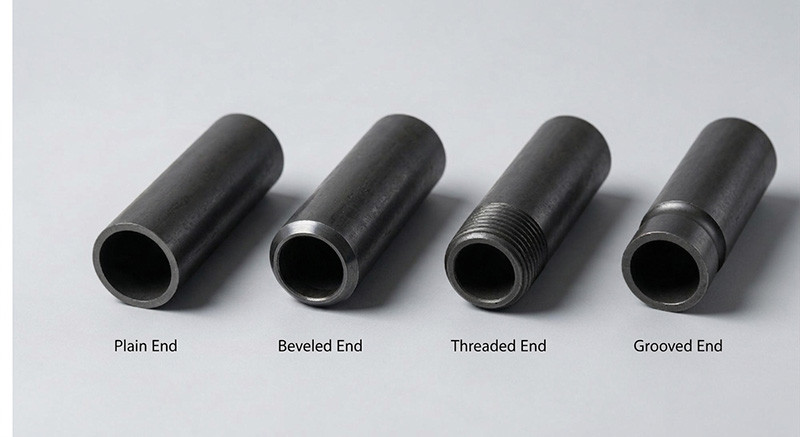
Common end options include:
Plain ends
Bevelled ends for welding
Threaded ends
Threaded and coupled ends
Grooved ends for mechanical piping systems
Common surface options include:
Black or uncoated steel pipe
Hot-dip galvanized steel pipe
Painted pipe
3PE-coated pipe
FBE-coated pipe
Other project-specified anti-corrosion systems
For example, this is a useful pipe description:
NPS 4, SCH 40, ASTM A53 Grade B, ERW, 6 m fixed length, bevelled ends, 3PE coating.
This description is far more useful than:
4-inch black steel pipe.
5. Check Quantity, Length, and Shipping Requirements
Length, quantity, theoretical mass, packing, and delivery terms all affect the final quotation.
Before requesting a price, confirm:
Pipe length: fixed length, single random length, or double random length
Required quantity: pieces, metres, or metric tons
End preparation
Coating or galvanizing requirement
Packing and marking requirement
Inspection and certification requirement
Destination port
Required delivery date
A thicker schedule generally means more steel per metre, higher total mass, and higher freight cost.
How to Calculate Steel Pipe Weight
A commonly used theoretical formula for carbon-steel pipe is:
W=0.02466 x (OD-t) x t
Where:
W = theoretical mass in kg/m
OD = outside diameter in mm
t = wall thickness in mm
Example: NPS 2 SCH 40
For NPS 2 SCH 40:
W ≈ 0.02466 x (60.3-3.91)x 3.91
W ≈ 5.44 kg/m
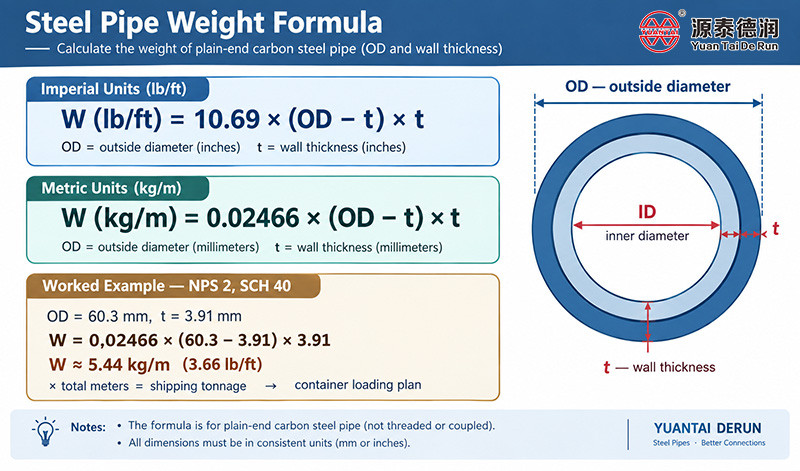
This is a theoretical plain-end value. Actual supplied mass can vary within applicable dimensional and mass tolerances. Coating, galvanizing, end preparation, couplings, and packing materials can also affect final shipment weight.
Common Questions Buyers Ask
Can I Specify Steel Pipe by OD × WT Instead of NPS × Schedule?
Yes.
OD × WT is commonly used for structural, mechanical, and other tubular products. For standard pipe, it is also helpful to provide the NPS, Schedule, and applicable dimensional standard.
For example:
OD 114.3 mm × WT 6.02 mm, equivalent to NPS 4 SCH 40, subject to ASME B36.10M dimensions.
Why Is the Actual Pipe Weight Different From the Chart?
Most published pipe-weight charts show theoretical or nominal values.
Actual supplied pipe may vary within permitted tolerances. Weight may also be affected by the actual cut length, coating, galvanizing, threaded ends, couplings, bevels, packing materials, and other order-specific requirements.
How Do I Know Which Schedule I Need?
The Schedule should be selected from the required wall thickness, not from a general pressure label.
For pressure piping, review the design pressure, design temperature, material grade, allowable stress, corrosion allowance, wall-thickness tolerance, system design code, and service conditions. Then select a standard schedule that meets or exceeds the calculated requirement.
What Should I Include in a Steel Pipe RFQ?
At minimum, include:
NPS or OD × WT
Schedule, if applicable
Material grade and standard
Manufacturing method, if required
Pipe length
Quantity
End preparation
Coating or surface treatment
Inspection and certification requirements
Packing requirements
Destination port
For pressure-piping applications, provide the design pressure, design temperature, fluid or service medium, corrosion allowance, and applicable design code where available.
Send Us Your Steel Pipe Requirements
If you have a line list, BOM, drawing, or purchasing specification, send us the available information for review.
We can help check the pipe dimensions, theoretical mass, coating requirements, packing method, and loading information before quotation. Mill test certificates can be provided in accordance with the agreed order specification and certification requirements. Third-party inspection can also be arranged before shipment where required.