Salt Spray Testing for Steel
- Share
- Issue Time
- Feb 25,2026
Summary
Salt spray testing, based on standards like ASTM B117, evaluates the corrosion resistance of steel products such as galvanized steel and PPGI. By simulating harsh environments, it helps buyers compare suppliers through indicators like time to red rust. Results are comparative, not exact lifespan predictions. Key factors include zinc coating, paint system, and production quality, making it a practical tool for selecting durable steel.
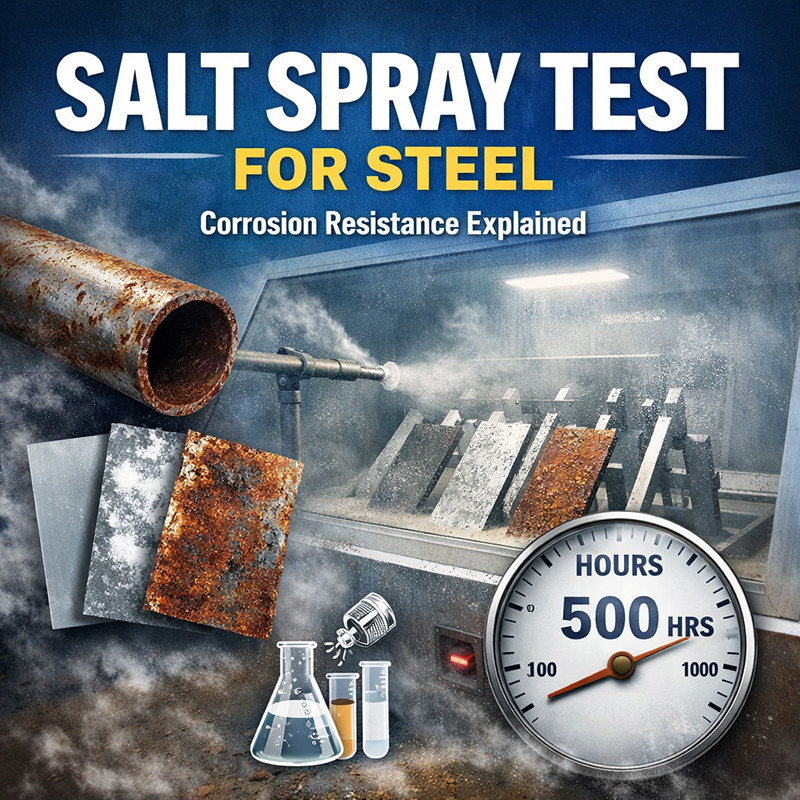
Salt Spray Testing for Steel: Corrosion Resistance Guide
If you are sourcing steel for infrastructure in coastal regions, high-humidity tropical zones, or heavy industrial belts, one question inevitably dominates the conversation: "How long will this last before the rust sets in?"
In the global steel market, products often look identical on the day of inspection. Standard Mill Test Certificates (MTC) are the essential baseline, confirming that a batch of galvanized pipes or PPGI coils meets its technical specifications upon leaving the factory. However, while the paperwork confirms the initial quality, the true test of the coating’s chemistry and integrity begins the moment the material is deployed and faces the corrosive reality of the environment.Some products fail within months, while others remain structurally sound for decades.
This performance gap is why the Salt Spray Test (SST)—specifically under the ASTM B117 standard—is the most critical benchmark for international buyers to understand.
What is a Salt Spray Test? (The Science of "Fast-Forwarding")
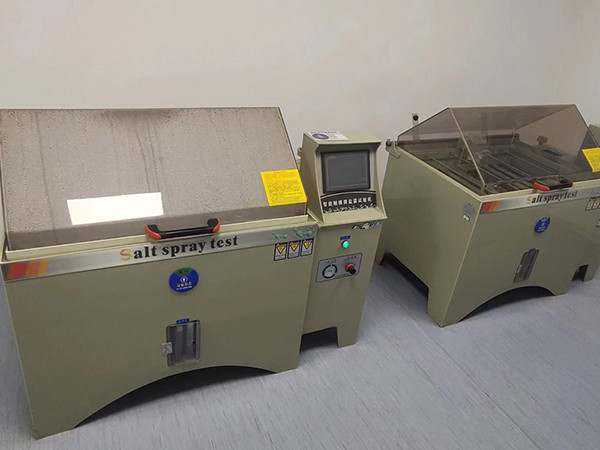
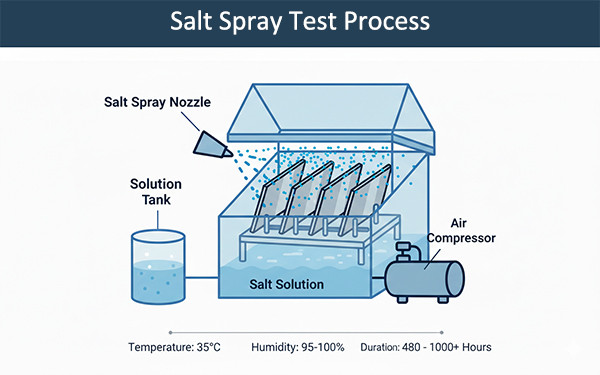
A salt spray test is an accelerated corrosion method designed to simulate years of environmental wear in a matter of days. Since waiting ten years to see if a roof sheet rusts is impractical for business, manufacturers use a controlled environment to "fast-forward" the oxidation process.
Inside a specialized chamber, steel samples are continuously blasted with a fine, atomized mist of 5% sodium chloride (NaCl) solution at a constant temperature of 35°C (95°F).
What is the core objective of SST?
The goal is not to perfectly replicate the complexity of nature, but to create a comparable baseline. It allows a buyer to see how a specific coating system—be it zinc, chrome, or polymer—reacts when its chemical defenses are pushed to the limit. For instance, a high-quality galvanized pipe that might last 20 years in a rural environment could show signs of failure within 500 hours inside a salt spray chamber.
Why This Matters: Risk Control in Procurement
To a seasoned procurement manager, salt spray hours are more than just lab data—they’re a safeguard for the project’s budget. When steel is shipped halfway across the world for a critical installation, it’s often destined for unforgiving climates. In these high-pressure environments, a subpar coating doesn't just mean rust; it means expensive site repairs and a damaged reputation.
· Coastal Jobsites: The salt in the air doesn't just sit there—it actively eats into the surface, causing "pitting" that can compromise the metal faster than you’d expect.
· Industrial Zones: These areas are brutal. Acid rain and airborne chemicals act like a solvent, stripping away protective coatings and leaving the raw steel exposed to the elements.
· Tropical/High-Humidity Climates: Constant moisture means the steel is essentially sitting in a permanent electrolyte bath, which keeps the corrosion process running.
A Real-World Scenario: A procurement manager once sourced "budget" galvanized square tubes for a fencing project in a high-salinity region in the Middle East. The material had a salt spray resistance of less than 120 hours. Within six months, the "white rust" had turned into deep "red rust," and the structural integrity was compromised. The cost of replacement and labor far exceeded the initial savings of 10% on the material price.
By demanding specific SST hours, you are essentially buying an insurance policy for your project’s lifespan.
Decoding the Results: Red Rust vs. White Rust
When reviewing a test report, many buyers make the mistake of looking only at the "total hours." To truly evaluate quality, you must distinguish between two types of oxidation:
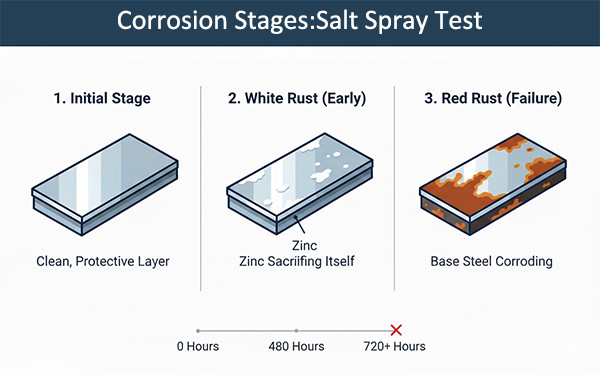
· White Rust (Zinc Oxide): You’ll see this as a chalky, white powder on the surface. It’s actually a sign that the zinc is doing exactly what it was designed to do: sacrificing itself to keep the steel safe. While it’s not a "failure" yet, it is your early warning light that the protective shield is being used up.
· Red Rust (Iron Oxide): This is the deal-breaker. Once you see red, the defense has been breached. It means the coating is gone and the environment is now eating directly into the base steel. At this stage, the clock is officially ticking on the product's lifespan.
| Test Duration (Hours) | Protection Level | Recommended Use Case |
| < 120 Hours | Low | Indoor furniture, temporary brackets, or dry storage. |
| 240 – 480 Hours | Standard | General outdoor construction, urban roofing, and fencing. |
720 – 1,000+ Hours | High | Marine environments, offshore platforms, and solar mounts. |
The Factors That Drive Performance
Two steel products with the same "Z120" (120g/m²) coating might perform differently in a test. Why? Because corrosion resistance is a result of the entire production system:
Zinc Coating Thickness: This is the most direct factor. Moving from Z120 to Z275 doesn't just double the protection; it can exponentially increase the time until red rust appears.
Paint Chemistry (PPGI/PPGL): Don't just tick the box for"color-coated."Standard PE (Polyester) is fine for a warehouse in a mild climate, but it chalks and degrades quickly under harsh UV rays or salt. If your project faces aggressive weather, PVDF (Polyvinylidene Fluoride) is your non-negotiable gold standard. Its chemical bonds are incredibly tough, keeping the color and protection intact.
Edge Creep Control: A steel sheet can have a perfect surface, but rust will always exploit the weakest link: the cut edges. Top-tier mills apply specific treatments to stop "undercutting"—that fatal flaw where moisture bypasses the surface and tunnels directly underneath the paint, peeling your coating off from the inside out.
The Substrate's "DNA": You can’t put a premium coating over garbage steel. If the base metal is full of impurities or high in sulfur, the primer never truly grips. The result? The material looks flawless leaving the port, but starts blistering and flaking within a year of installation.
SST vs. Real-World Performance
It is vital to remain realistic: Salt spray hours do not equal a direct calendar lifespan. In the real world, steel faces challenges the salt spray chamber does not:
UV Radiation: Sunlight breaks down the chemical bonds in paint, making it brittle.
Thermal Cycling: The expansion and contraction of steel during day/night cycles can create micro-cracks in coatings.
Mechanical Wear: Sand and wind physically abrade the surface.
Therefore, you should view the SST as a quality indicator. If Product A lasts 1,000 hours and Product B lasts 500 hours, Product A is undeniably the superior material, but you cannot guarantee it will last exactly twice as long in a specific city.
Conclusion
In the international steel trade, "cheap" is often the most expensive word in a buyer’s vocabulary. The Salt Spray Test is the ultimate filter; it separates world-class manufacturers from those who cut corners on chemistry and curing.
By prioritizing certified SST performance over the lowest price per ton, you aren't just buying steel—you are buying peace of mind. You are ensuring that your project stands its ground against the elements, protecting both your structural integrity and your professional reputation.