Square vs C-Channel Steel: Bending, Torsion & Stability Guide
- Share
- Issue Time
- Jan 21,2026
Summary
In structural engineering, dimensions and thickness are only half the story. The real performance gap between square tubing and C-channel is defined by Section Geometry—how a shape distributes mass to resist bending, twisting, and total collapse. In real engineering, the section shape controls how a member bends, twists, and maintains stability under different loads.
Square vs C-Channel Steel: Bending, Torsion & Stability Guide
In structural engineering, dimensions and thickness are only half the story. The real performance gap between square tubing and C-channel is defined by Section Geometry—how a shape distributes mass to resist bending, twisting, and total collapse. In real engineering, the section shape controls how a member bends, twists, and maintains stability under different loads.
These behaviors can be explained using three core structural properties: Ix, Iy, and J, along with material properties and geometric stability factors like shear center and local buckling.
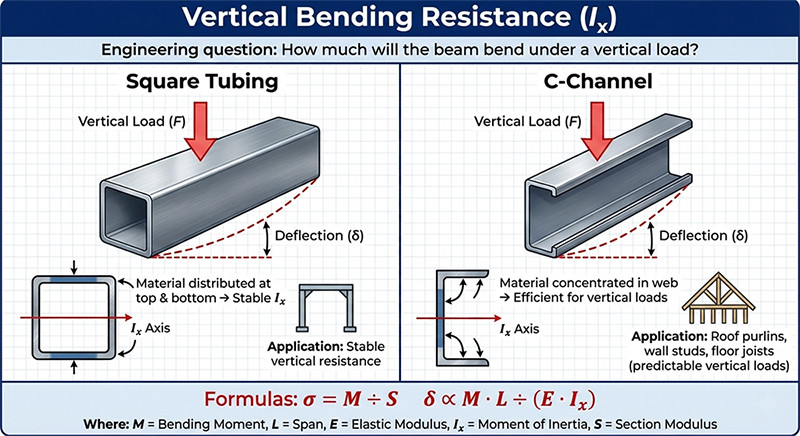
Vertical Bending Resistance (Ix)
Engineering question:
How much will the beam bend under a vertical load?
Vertical bending stress and deflection follow these relationships:
σ = M ÷ S
δ ∝ M · L ÷ (E · Ix)
Where:
M is the bending moment caused by the load and span
L is the span length
E is the elastic modulus of steel, describing material stiffness
Ix is the moment of inertia resisting vertical bending
Key interpretation:
Since E is nearly constant for structural steel, vertical bending performance is controlled mainly by Ix, which depends on section geometry.
Square tubing: Material is distributed at top and bottom, giving stable vertical bending resistance.
C-channel: Material is concentrated in the web, performing very efficiently for vertical loads.
Application:
This is why C-channel is widely used in roof purlins, wall studs, and floor joists, where loads are mainly vertical and predictable.
Lateral Bending Resistance (Iy)
Engineering question:
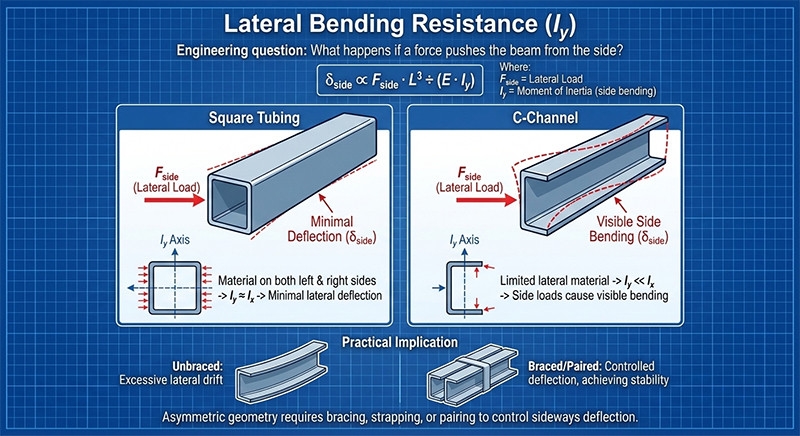
What happens if a force pushes the beam from the side?
Sideways deflection follows:
δ_side ∝ F_side · L³ ÷ (E · Iy)
Where:
F_side is the lateral load (wind, misalignment, vibration)
Iy is the moment of inertia resisting side bending
Key takeaway:
Even when vertical bending capacity is adequate, a small Iy may still cause excessive lateral drift.
Square tubing: Material on both left and right sides → Iy ≈ Ix → minimal lateral deflection.
C-channel: Limited lateral material → Iy ≪ Ix → side loads can cause visible bending.
Practical implication:
The asymmetric geometry of C-channel provides minimal resistance to twisting. As a result, bracing, strapping, or installing sections in pairs is essential to control sideways deflection and achieve design stability.
Torsional Resistance (J) and Shear Center
Engineering question:
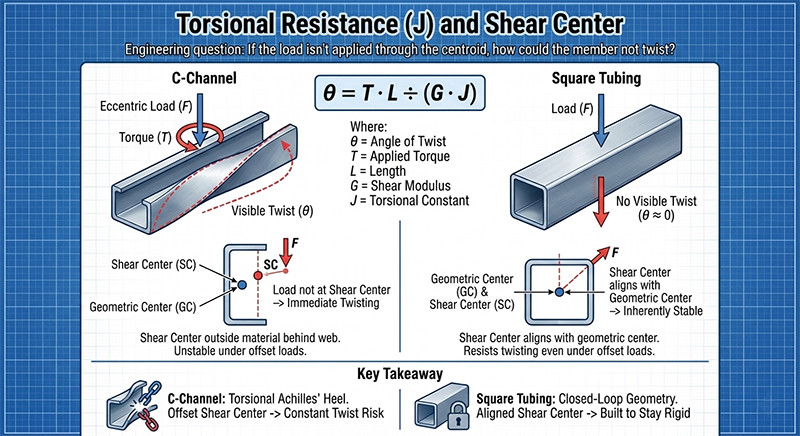
If the load isn't applied through the centroid, how could the member not twist?
Torsional behavior:
θ = T · L ÷ (G · J)
Where:
θ is the angle of twist
T is the applied torque from eccentric loading
G is the shear modulus of steel, describing resistance to shear deformation
J is the torsional constant of the section
Shear Center Matters:
C-Channel: The shear center is located outside the material, behind the web. Any load not applied precisely at this point causes immediate twisting.
Square Tubing: Because the shear center of square tubing aligns perfectly with its geometric center, the member remains inherently stable and resists twisting—even under offset loads.
Key takeaway:
Torsional instability is the Achilles' heel of the C-channel. Its offset shear center makes twisting a constant risk, whereas square tubing’s closed-loop geometry is built to stay rigid.
Stability and Local Buckling
Even if Ix, Iy, and J are sufficient, structural stability can still control failure.
C-Channel:
Free flange (wing) is prone to local buckling under compression or bending.
Highly sensitive to lateral-torsional instability.
Square Tubing:
Four corners constrain each other → excellent local stability.
Maintains global and local stability without additional bracing.
Engineering implication:
C-channels are rarely 'plug-and-play'—they typically demand extra bracing or back-to-back pairing to stay stable. In contrast, square tubing provides out-of-the-box rigidity, handling both local and global stress without the need for add-ons.
Material Properties: E and G
Elastic Modulus (E): Measures stiffness under axial or bending loads. Answers:
How much will steel elastically deform before springing back?
Typical structural steel: E ≈ 200 GPa
Shear Modulus (G): Measures stiffness under shear or torsion. Answers:
How much will steel twist under applied torque?
Typical structural steel: G ≈ 77–80 GPa
Note: Since E and G are nearly constant for steel, differences in bending or twisting performance come from section geometry (Ix, Iy, J), not material grade.
Engineering Applications
Construction (Purlins, Studs)
Load: Mainly vertical
Bracing: Frequent and regular
Critical property: Ix
✅ C-channel is economical and effective.
Trailer Chassis and Equipment Frame
Load: Dynamic, eccentric, moving
Critical properties: Iy and J
Requirement: Dimensional stability and torsional resistance
✅ Square tubing provides consistent stiffness and durability.
Industrial Machinery Frames
Load: Eccentric, vibration-prone
Requirement: Predictable performance, local and global stability
✅ Square tubing outperforms C-channel in multi-directional stress.
Summary Table
| Property | Square Tubing | C-Channel |
| Ix (vertical bending) | Strong | Strong |
| Iy (side bending) | Strong | Weak |
| J (torsion) | Very strong | Weak (depends on shear center) |
Shear Center | Geometric center → stable | Outside material → easy twist |
Local Buckling | Constrained corners → stable | Free flange → prone to local buckling |
Takeaway:
Square tubing is the ultimate structural all-rounder; its closed geometry handles messy, real-world load placements and resists buckling without extra help. C-channel is a vertical specialist—highly efficient when the load is predictable, but it gets finicky the moment the weight shifts or the flanges lack support.
Final Recommendation
Use square tubing for frames, trailers, equipment, and multi-directional load applications, where torsion, side bending, and local stability are critical.
Use C-channel for building structures with predictable vertical loads, where bracing can mitigate torsion and local buckling.
Because E and G are material properties and remain nearly constant, the performance differences are driven by geometry (Ix, Iy, J, shear center, and flange support) rather than steel grade.