Why Smart Piping Systems Need High Quality Steel
- Share
- Issue Time
- Mar 20,2026
Summary
The infrastructure world is currently obsessed with "smart" labels. We see it everywhere: smart cities, intelligent water grids, and digital twin pipelines. On paper, the vision is flawless. We imagine a vast network of IoT sensors, real-time pressure monitors, and AI-driven leak detection algorithms that make pipe bursts a thing of the past. It’s a compelling future, and one that we at Yuantai Derun Group are proud to support.
Why Smart Piping Systems Need High Quality Steel
The infrastructure world is currently obsessed with "smart" labels. We see it everywhere: smart cities, intelligent water grids, and digital twin pipelines. On paper, the vision is flawless. We imagine a vast network of IoT sensors, real-time pressure monitors, and AI-driven leak detection algorithms that make pipe bursts a thing of the past. It’s a compelling future, and one that we at Yuantai Derun Group are proud to support.
However, after decades in the steel manufacturing trenches, we’ve noticed a dangerous trend. Project planners are becoming so enamored with the "brain" (the software) that they are neglecting the "skeleton" (the steel pipe). There is a growing illusion that sophisticated digital monitoring can compensate for mediocre material quality.
The truth? It’s exactly the opposite. Digitalization doesn’t make material quality less important—it makes it critical.
The "Precision Gap": How Manufacturing Flaws Sabotage Sensors
-------------------------------------------------------------------------------------
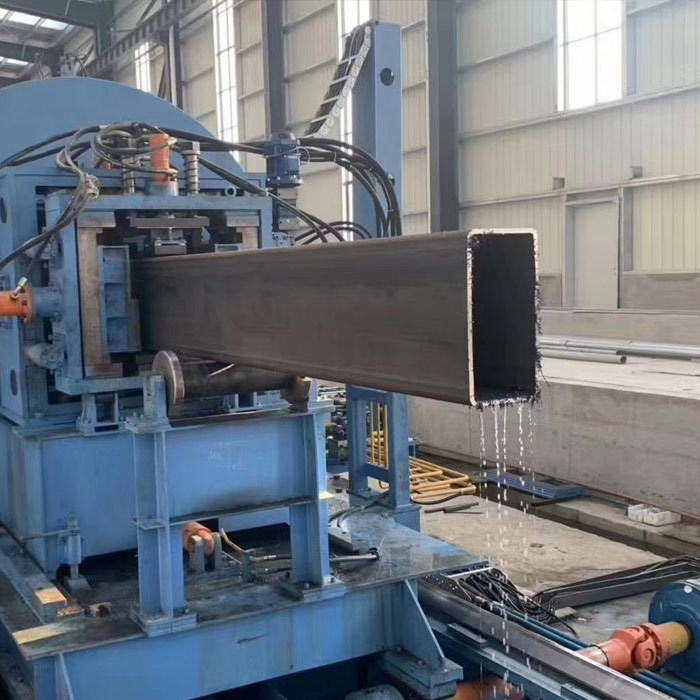
To understand why steel pipe selection is the ultimate bottleneck for smart systems, you have to look at the sensors themselves. Most intelligent networks rely on ultrasonic or electromagnetic sensors to track flow, pressure, and wall thinning. These devices aren't magic; they are precision instruments that require a consistent physical baseline to function.Imagine you've installed an expensive ultrasonic flow meter on a pipeline. This sensor sends sound waves through the pipe wall to measure what’s happening inside. Now, if that pipe has inconsistent wall thickness or excessive ovality—defects often found in low-tier manufacturing—the sound wave refracts unpredictably.
The result? The "smart" system starts reporting ghost leaks or pressure drops that don't exist. We’ve seen cases where companies spent millions on software upgrades to fix "data noise," only to realize the noise was actually caused by the physical vibration of a poorly welded ERW seam or a distorted R-angle in a structural support. At Yuantai Derun, we don't just produce pipes; we produce "sensor-ready" infrastructure. By tightening our production tolerances far beyond standard requirements, we ensure that when your sensor sends a signal, it’s reading the fluid, not the flaws in the steel.
Corrosion: The Silent Killer of Digital Investments
-------------------------------------------------------------------------------------
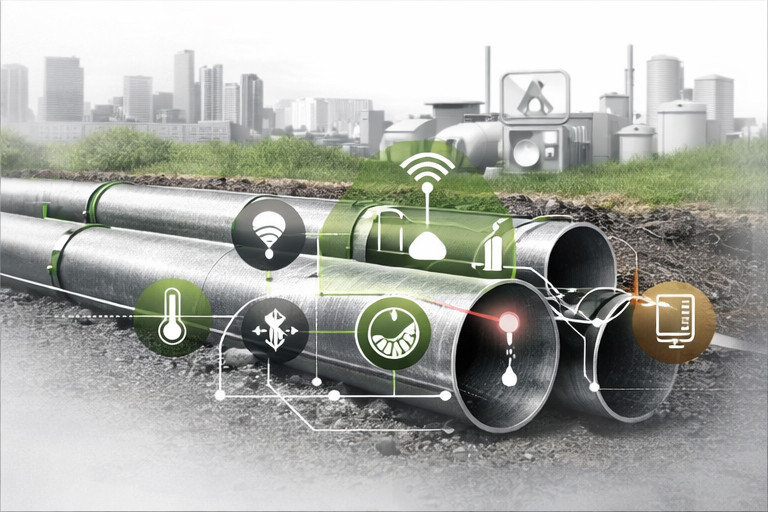
Another hard truth that digital enthusiasts often ignore is the lifespan of the hardware. You can have the most advanced IoT transmitter in the world, but if it's bolted to a pipe that’s corroding from the inside out, your investment is on a countdown timer.In smart piping systems, the anti-corrosion coating isn't just a "nice-to-have" feature; it’s an insurance policy for the electronics. This is why we advocate so strongly for high-performance low carbon steel pipes paired with advanced coating technologies.
For buried municipal water lines, 3PE is non-negotiable for longevity. For industrial utility lines where sensors are exposed to the elements, Hot-dip Galvanized Steel provides the necessary metallurgical bond to prevent the "rust creep" that can interfere with electronic mounts. When the physical steel is protected by a 610g/m2 zinc layer, the integrated sensors can do their job for decades rather than years. The synergy between a robust physical barrier and a digital monitor is what creates a truly "smart" asset.
The New Frontier: Hydrogen and the Energy Transition
-------------------------------------------------------------------------------------
The most urgent example of why material science must lead digitalization is the rise of hydrogen transportation pipelines. As the world pivots toward green energy, the industry is racing to build "Smart Hydrogen Grids."Hydrogen, however, presents a unique physical challenge: hydrogen embrittlement. Hydrogen molecules are tiny; they can migrate into the crystalline structure of the steel, making it brittle and prone to sudden, catastrophic failure.
In this scenario, a "smart" sensor might tell you a leak is happening, but it’s too late to fix the fundamental material failure. Safely scaling hydrogen infrastructure from small pilot projects to massive, standardized networks requires a sophisticated approach to steel pipe selection. We are currently developing specialized low-carbon, high-strength pipes designed specifically to resist hydrogen-induced cracking. In these high-stakes environments, the "intelligence" starts at the molecular level of the steel, long before the first sensor is even turned on.
Beyond Fluid: Structural Integrity and R-Angle Precision
-------------------------------------------------------------------------------------
It’s also important to remember that not all smart pipes carry fluids. In many smart city projects, square and rectangular hollow sections are used as the structural "smart poles" or conduits that house the city’s digital nerves—fiber optics, 5G small cells, and traffic sensors.Here, the challenge is structural precision. If the R angle of a rectangular tube is inconsistent, the internal mounting brackets for the electronics won't fit correctly. This leads to forced installations, compromised seals, and eventually, moisture ingress that fries the digital components. By perfecting the R-angle precision in our hollow sections, Yuantai Derun ensures that the "smart" components have a secure, weather-tight home.
Building for the Next Century
--------------------------------------------------------------------------
The future of infrastructure is undeniably digital, but that digital future is built on a physical foundation of iron and carbon. As we move toward 2026 and beyond, the most successful projects will be those that treat steel manufacturing as a high-tech discipline.
Digital monitoring is excellent at telling you what is happening now. But high-quality, precision-engineered steel pipes are what guarantee what will happen in fifty years.
If you are a procurement officer or a project engineer in Riyadh, Singapore, or Madrid, the goal isn't just to buy a pipe that meets a minimum spec. The goal is to select a material that empowers your digital tools to work at their peak performance.
At Yuantai Derun Steel Pipe Group, we are ready to be that foundation. Whether your project involves complex LSAW line pipes for energy or precision galvanized hollow sections for smart urban grids, we bring the manufacturing rigor that makes "smart" possible.Let’s build an infrastructure that is as strong as it is intelligent.