Yuantai Derun at Big 5 Global 2026: Steel Hollow Sections, Stand 2G45
- Share
- Issue Time
- Nov 27,2026
Summary
What Gulf buyers asked at stand 2G45: what this climate does to steel, why ASTM and EN turn up on the same drawing, and where an EPD fits.
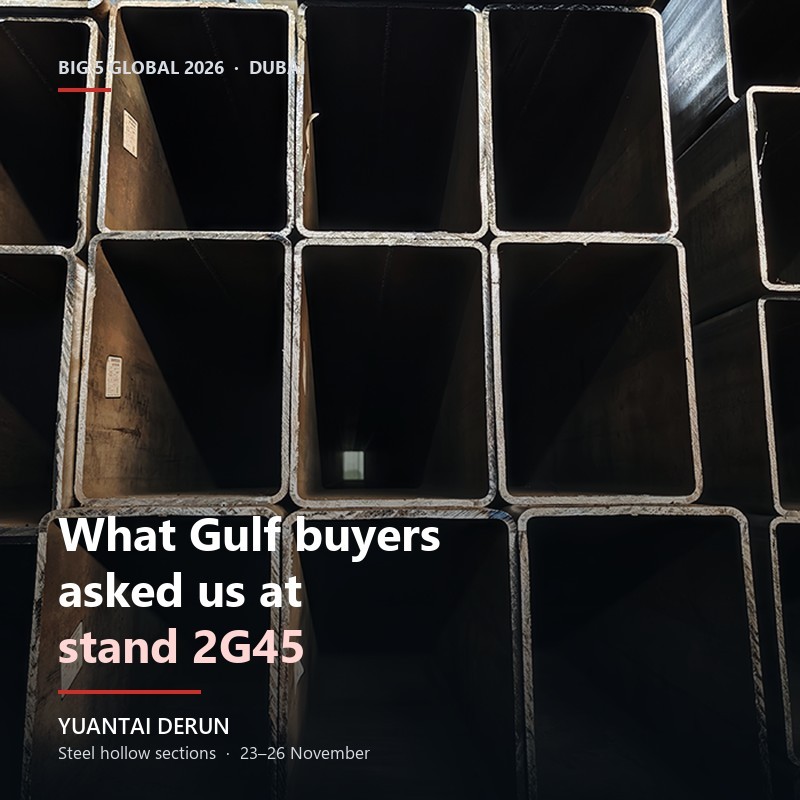

What Gulf buyers asked us at stand 2G45
Yuantai Derun exhibited at the 47th Big 5 Global in Dubai from 23 to 26 November, on stand 2G45. Four days of square, rectangular and round hollow sections, and a steady stream of technical questions from the people specifying and fabricating with them. Most came back to the same thing: what this climate does to steel, and what the paperwork has to say about it. Here is what we told people.
The show, in the organiser’s own figures
Big 5 Global calls itself the largest construction and building materials exhibition in the Middle East. The organiser’s figures for this edition were more than 1,800 exhibitors from 165 countries, with around 65,000 visitors expected across the four days.
At that size nobody sees the whole floor. The visitors who got something out of the week had a shortlist and a size list before they arrived. The ones who wandered generally left with a bag of brochures.
What this climate does to a hollow section
A few things came up again and again, and they explain why a specification copied from a European project does not always survive contact with a Gulf site.
Corrosivity here is three different conditions. A site in Jebel Ali, a site in Al Ain and a site in Riyadh are three different exposures even when the drawings look identical. ISO 9223 gives you the categories, the category decides the coating, and the coating decides how long the structure lasts. The steel grade tells you very little about that.
Heat damages coatings differently than rain does. Systems that hold up in a temperate climate chalk and lose gloss quickly under Gulf sun. The daily temperature swing pulls moisture into joints and voids. Detailing that sheds water in a wet climate can trap it here, because rain arrives rarely and hard instead of often and gently.
Salt carries further inland than most specifications assume. That is why hot-dip galvanised protection shows up on structures well away from the coast, and why a painted system specified for an inland site sometimes fails earlier than anyone expected.
The standards that turn up on Gulf drawings
Gulf projects do not run on one standard. International consultants, regional developers and government bodies all write specifications, so a single drawing set often carries a mix.
| What you will see | Where it comes from | What it governs |
|---|---|---|
| ASTM A500 / A501 | US-engineered projects and many developer specifications | Cold formed and hot formed structural tubing, inch sizes, grade by yield |
| EN 10219 / EN 10210 | European consultants and international tender documents | Cold formed and hot finished hollow sections, metric sizes, J0H and J2H impact grades |
| EN ISO 1461 | Almost every galvanising clause | Minimum zinc coating mass, set by base metal thickness |
| ISO 12944 | Painted systems and duplex coatings | Corrosivity category and the coating system specified for it |
| ISO 9223 | Durability and maintenance planning | Atmospheric corrosivity class, which drives the two rows above |
| BS 5950 / EN 1993 | Structural design, older and current practice | How the section is used, and therefore how much of it you need |
You will see an ASTM section and an EN galvanising clause on the same drawing, and that is legal. It happens when the structural engineer and the durability consultant come from different traditions.
Sizes do not convert. An A500 grade is not an EN 10219 grade with a different label, and an inch schedule will not map onto a metric range. If your document mixes the two, settle which one governs before the enquiry goes out. The answer changes the price.
What gets built here
Four applications came up most often.
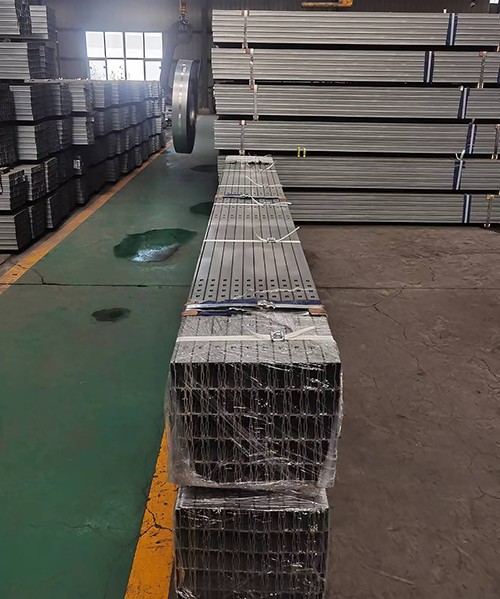
Utility-scale solar. Ground-mounted piles, torque tubes and purlins, mostly thin-wall square and rectangular section, mostly galvanised or zinc-aluminium coated. The Gulf is building solar fast enough that wall thickness tolerance and coating mass have become commercial questions rather than technical footnotes. A tenth of a millimetre across thousands of tonnes is a different project. Our own range covers photovoltaic mounting profiles as well as the sections behind them.
Industrial sheds, logistics and light structures. Purlins, trusses and frames, bought in large quantities, where reliable delivery matters as much as the unit price.
Transport and civic infrastructure. Barriers, gantries, station canopies and shade structures, usually specified by a consultant against a recognised standard, often with documented inspection required.
Modular and prefabricated construction. A growing share, and the one where the tube is cut and drilled to length before it ships. The assembly happens in the customer’s plant rather than ours, but the cut length and the end squareness have to be right at our end for it to work at theirs. Here they stop being tolerances and become the job.
All four are exposed, all four are expected to last with little maintenance, and all four are bought by the project rather than by the kilogram. That last point matters more than it sounds, and it comes back to the carbon figure below.
Where an environmental declaration fits into this market
One more subject came up often enough to be worth a section, although it is not something we had on the stand. We hold a third-party verified environmental product declaration for our hollow sections: EN 15804 and ISO 14025, registered as TIA:TI01:2026:EP, with a declared range of 1.95 to 2.21 kg CO2e per kilogram over modules A1 to A3, depending on steel grade. It is a document we can supply, and it is worth knowing it exists when you are pricing a project.
The reason it comes up is that green building frameworks across the region all cover materials. Estidama in Abu Dhabi, Al Sa’fat in Dubai and Mostadam in Saudi Arabia each have their own route into that, and the international consultants working here often carry LEED or WELL requirements into local projects. Where a project does carry a materials credit, a supplier who can produce a verified declaration is easier to specify than one who cannot.
What we took away from the four days
Buyers here arrive prepared. The conversations worth having started with a size schedule, a grade and a destination port. People who asked for a catalogue usually did not have a live project, and the people with a live project usually had a schedule already drawn up.
Protection systems get argued about more than steel. Galvanising thickness, duplex coating, whether the site is really C4 or C5, whether the coating survives handling and site storage. None of that is settled by a grade name, and all of it affects how long the coating does its job.
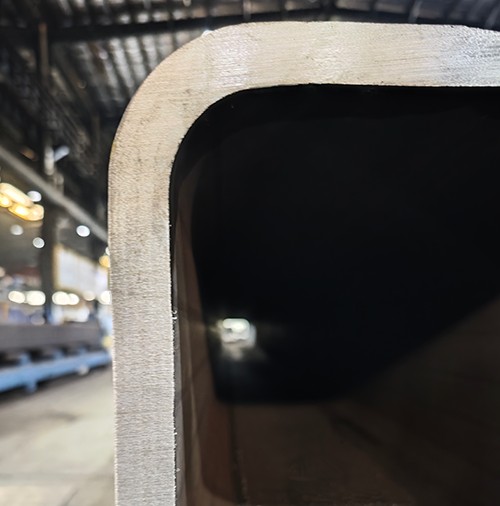
Cut ends persuade faster than data sheets. A good number of the conversations started with someone putting a caliper on a wall or turning a cut end over to look down the bore. We could have emailed those people a PDF. It would not have done the same thing, which is why we still pay for a stand.
If you could not make it
Four days is a short window, and not everyone can be in Dubai in the last week of November. The people who stood at 2G45 answer the same questions by email, and a drawing works as well as a size list if that is what you have.
We expect to be back at Big 5 Global in 2027. The show moves to Dubai Exhibition Centre that year, so the address will change even if nothing else does.
Send your size schedule with the standard it is written to, ASTM or EN, along with the surface condition, the exposure category and the destination port. If a submission needs the declaration, say so and we will send the part of it that covers your grade and size, with the arithmetic shown separately from the verified figure.
Send an enquiryTianjin Yuantai Derun Pipe Manufacturing Group Co., Ltd. · Daqiuzhuang Industrial Area, Jinghai, Tianjin, China. EPD registered as TIA:TI01:2026:EP with Global GreenTag International, verified by an independent third party. Exhibition facts are taken from Big 5 Global’s published material and quoted as the organiser states them.