What are the yield strength and mechanical requirements for ASTM A501 Grade B and Grade C?
- Share
- Issue Time
- Jul 22,2026
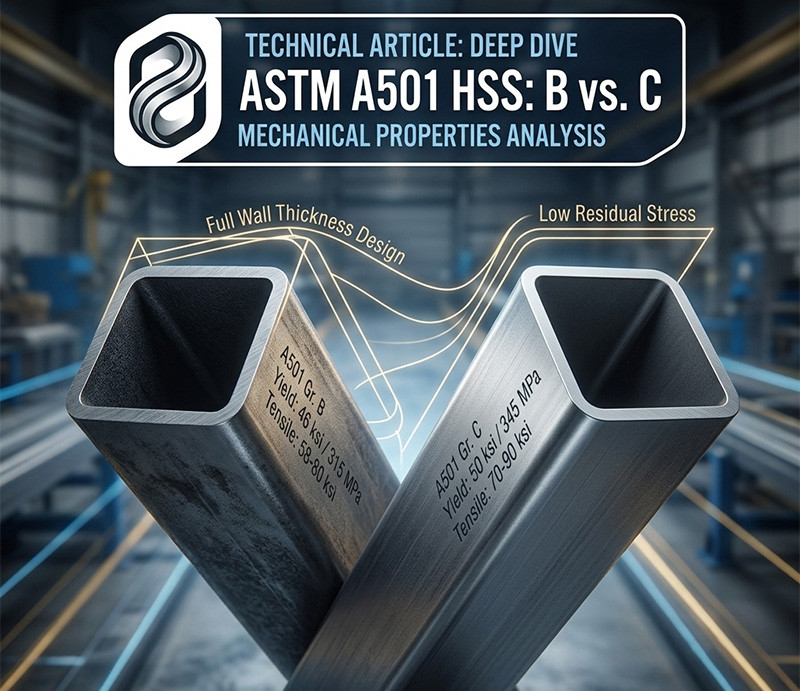
ASTM A501 / A501M specifies two primary grades for hot-formed structural hollow sections (HSS): Grade B and Grade C. Both offer high strength, excellent ductility, and more uniform mechanical properties than cold-formed HSS, making them suitable for demanding structural applications.
| Mechanical Property | ASTM A501 Grade B | ASTM A501 Grade C | ASTM A500 Grade B |
| Minimum Yield Strength | 46 ksi (315 MPa) | 50 ksi (345 MPa) | 46 ksi (315 MPa) |
| Minimum Tensile Strength | 58–80 ksi (400–550 MPa) | 70–90 ksi (485–620 MPa) | ≥58 ksi (400 MPa) |
| Minimum Elongation(in 2 in./50 mm) | 23% | 21% | Varies by section thickness |
CVN Impact Testing | Required where specified by ASTM A501 | Required where specified by ASTM A501 | Not required by ASTM A500 |
AISC 360 Design Wall Factor | 1.00 × t | 1.00 × t | 0.93 × t |
Compared with ASTM A500, ASTM A501 is produced by hot-forming or heat treatment, which significantly reduces residual stresses and provides more uniform mechanical properties throughout the cross-section. As a result, AISC 360 permits designers to use the full nominal wall thickness (1.00 × t) for ASTM A501 HSS, while ASTM A500 uses an effective wall thickness of 0.93 × t.
For projects involving bridges, seismic-resistant structures, crane girders, or low-temperature service, ASTM A501 is often preferred because of its consistent structural performance. When sourcing internationally, request an EN 10204 Type 3.1 Mill Test Certificate (MTC) to verify the material's chemical composition, mechanical properties, and impact test results where applicable.