Why are pipe-end out-of-roundness tolerances so strict for offshore piling?
- Share
- Issue Time
- Aug 11,2026
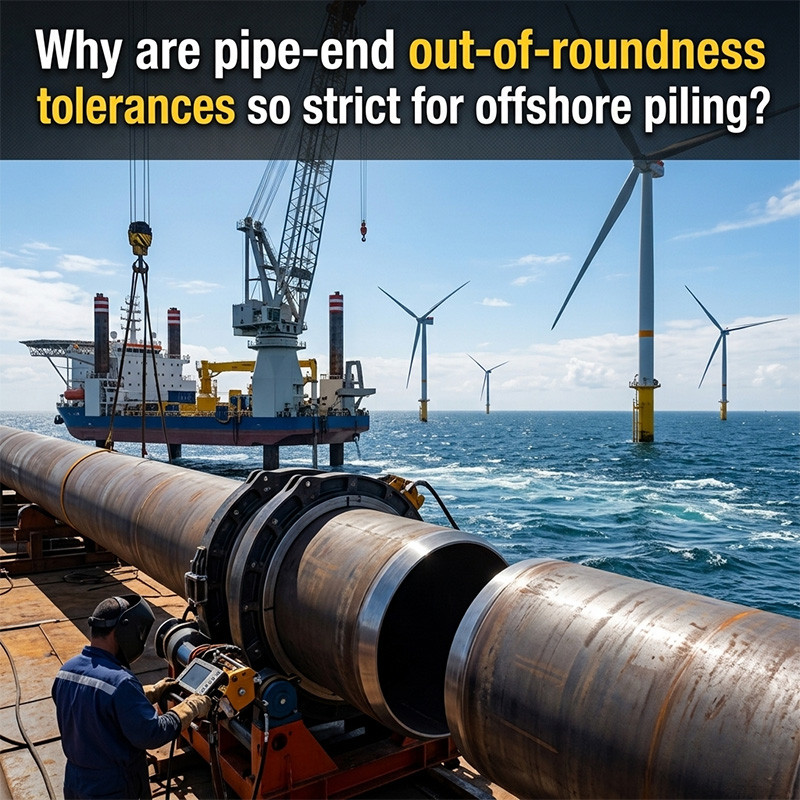
A: Offshore installation vessel day-rates are exceptionally high. When pipe-end dimensions, ovality, or bevel angles deviate from strict tolerances, field fit-up and circumferential welding on the installation barge grind to a halt—costing tens of thousands of dollars per hour in vessel downtime.
High-Speed Offshore Welding: Automated counter-beveling and orbital welding systems used on offshore barges require near-perfect pipe-end roundness and uniform wall thickness to achieve full-penetration welds without burn-through or root defects.
Eliminating Field Correction Delay: Correcting out-of-round pipe ends manually with hydraulic clamps at sea is hazardous, time-consuming, and directly inflates marine installation budgets.
The Role of Mechanical Expansion: High-grade LSAW offshore piling undergoes full-length cold mechanical expansion during manufacturing. This process locks in tight end-tolerances (for roundness, outer diameter, and straightness) while relieving internal residual forming stress—ensuring immediate alignment and rapid field welding on site.
At Yuantai Derun, we maintain strict dimensional controls on outer diameter, wall thickness, ovality, and end-bevel angles for heavy structural pipe. Every order is delivered strictly to client drawings and international tolerance standards, supported by complete dimensional and visual inspection reports.