Cold-formed (EN 10219) vs Hot-finished (EN 10210) hollow sections: how do I choose for my project?
- Share
- Issue Time
- Sep 4,2026
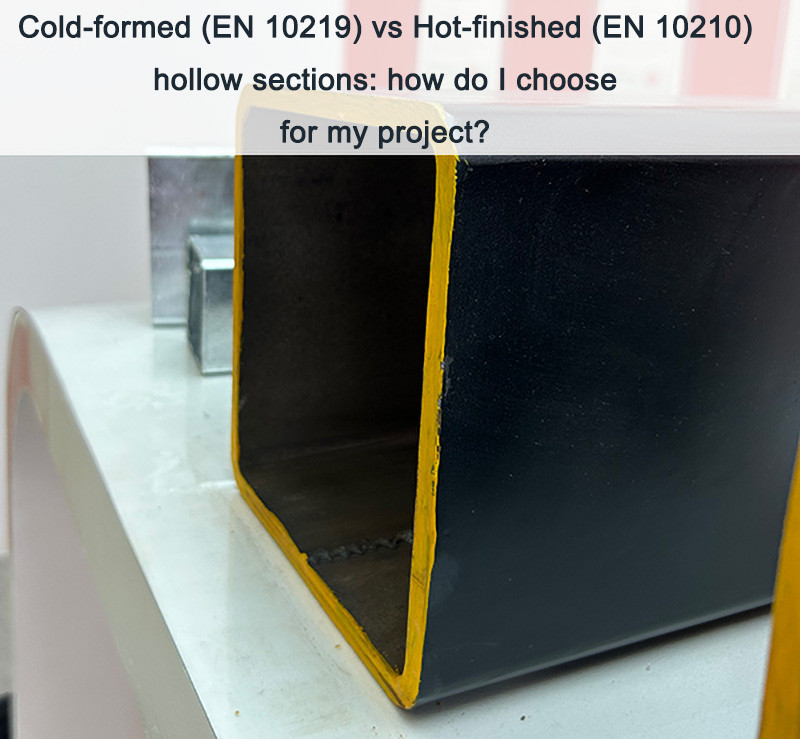
Selection depends directly on the structural stress profile, environmental conditions, and budget requirements of the application:
1.Choose Cold-Formed (EN 10219) When:
Priority: Cost efficiency, tight dimensional tolerances, and excellent surface finish.
Best Applications: General building frames, static architectural steelwork, residential/commercial column grids, secondary structural supports, and standard agricultural framing.
Key Advantage: High strength-to-weight ratio produced at lower manufacturing energy costs.
2.Choose Hot-Finished / Normalized (EN 10210) When:
Priority: Controlling internal residual manufacturing stress, avoiding corner embrittlement, and guaranteeing uniform mechanical ductility throughout the section profile.
Best Applications: Dynamic loading structures, heavy bridge girders, crane booms, offshore jackets/piling, structural nodes subjected to severe low-temperature fatigue, or structures requiring certified fire-resistance performance.
Key Advantage: Complete stress relief enables post-weld heat treatment, hot-dip galvanizing without micro-cracking risk, and enhanced structural safety under cyclic impact.
Decision Rule: Let the structural design engineer, loading conditions (static vs dynamic), and regional specifying standards govern the choice—EN 10219 for economical static structures; EN 10210 for heavy, high-consequence dynamic engineering.